As a business owner, it’s important for me to prioritize the safety of sensitive client information that is shared with me. Finding a product like Redactable is a game changer in the legal and insurance industry! It will give you peace of mind knowing that you are safeguarding client information while saving time during your busy workday. It’s a win-win, and I highly recommend Redactable!
Faster, Safer Real Estate Redaction Software
Protect buyer and seller data in every contract, title, loan, and disclosure with AI-powered redaction built for real estate professionals.

AI-powered precision redacts sensitive information instantly
Reduce human error and redaction time by up to 98%
SOC 2 Type II and HIPAA-compliant platform

or Try for free



Trusted by





.svg)
Results for Real Estate Teams Using Redactable

98%
Time savings compared to Adobe

30X
Faster than manual redaction
The Real Challenges With Real Estate Redaction

Document Volume Is Unmanageable Without Automation
Purchase agreements, loan applications, closing disclosures, title commitments, HUD-1 forms, deeds, survey documents, appraisal reports, and wire instructions all contain sensitive data. Manually reviewing every page of every file before it's shared is unrealistic and could cost deals.

Real Estate Documents Are Shared With Many Parties
A single transaction file might go to a mortgage lender, a title company, a closing attorney, a buyer's agent, and a seller's agent before it's done. Each transfer is a potential exposure point. Unredacted sensitive information creates legal risk and opportunities for fraud.

Scanned Deeds, Title Records, and Legacy Files Create Gaps
Older deeds, title policies, survey maps, handwritten disclosure forms, and faxed loan documents are common in real estate, and most redaction tools can't reliably process image-based PDFs. Sensitive data inside those files goes undetected unless you have OCR that can read them first.

Protected Parties Require a More Careful Process
Domestic violence survivors, law enforcement officers, judges, and medical professionals are entitled by law to have their property addresses and personal identifiers shielded from public records. You need a redaction process that flags them and applies the right level of protection.

Public Records and Commercial Transactions Need Precision
Public land records carry specific obligations under state address-privacy confidentiality programs, and a redaction error here can break the chain of title. Commercial transactions bring a separate set of sensitivities: rent rolls, due diligence packages, environmental reports, and investor materials.
Why Real Estate Teams Choose Redactable
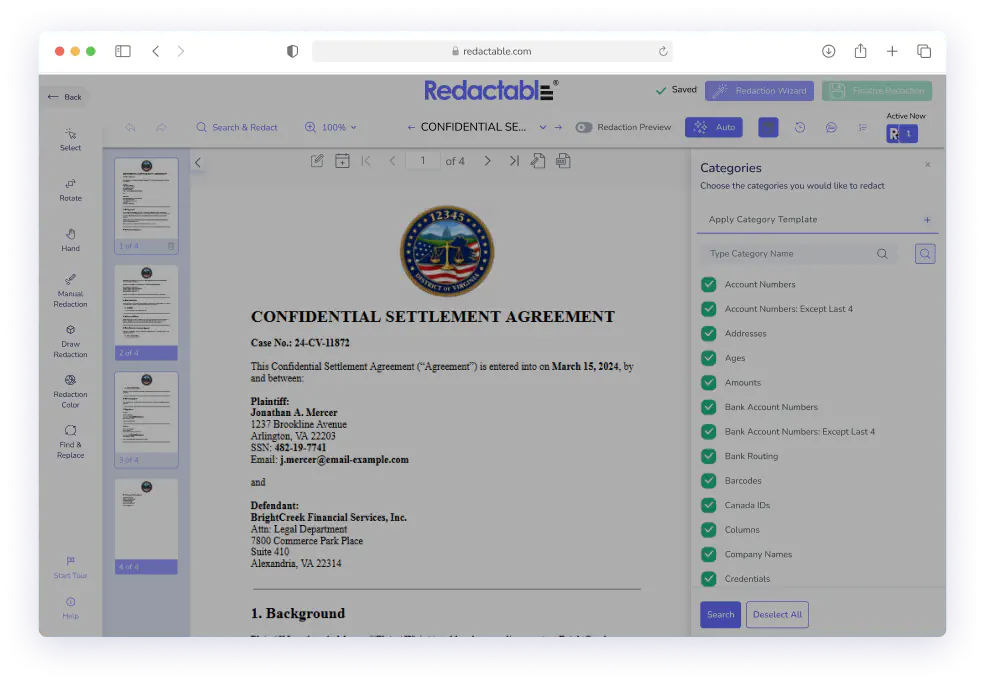
Automatic PII and Financial Data Detection
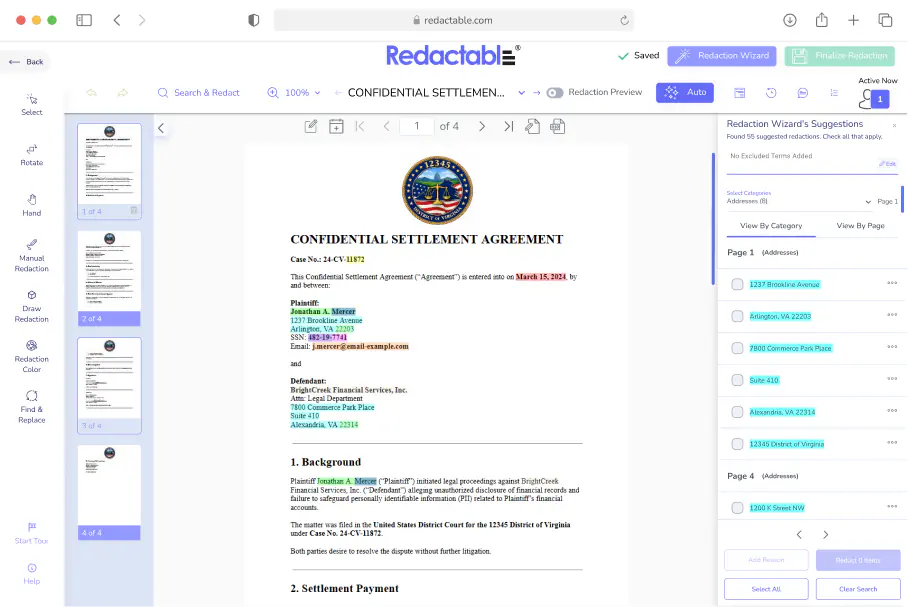
Redactable's AI scans every document and flags the identifiers that matter most in real estate: Social Security numbers, bank account and routing numbers, tax ID numbers, driver's license numbers, credit card details, contact information, and property addresses for protected individuals.
All you have to do is review what's flagged and confirm.


Permanent, Irreversible Redaction
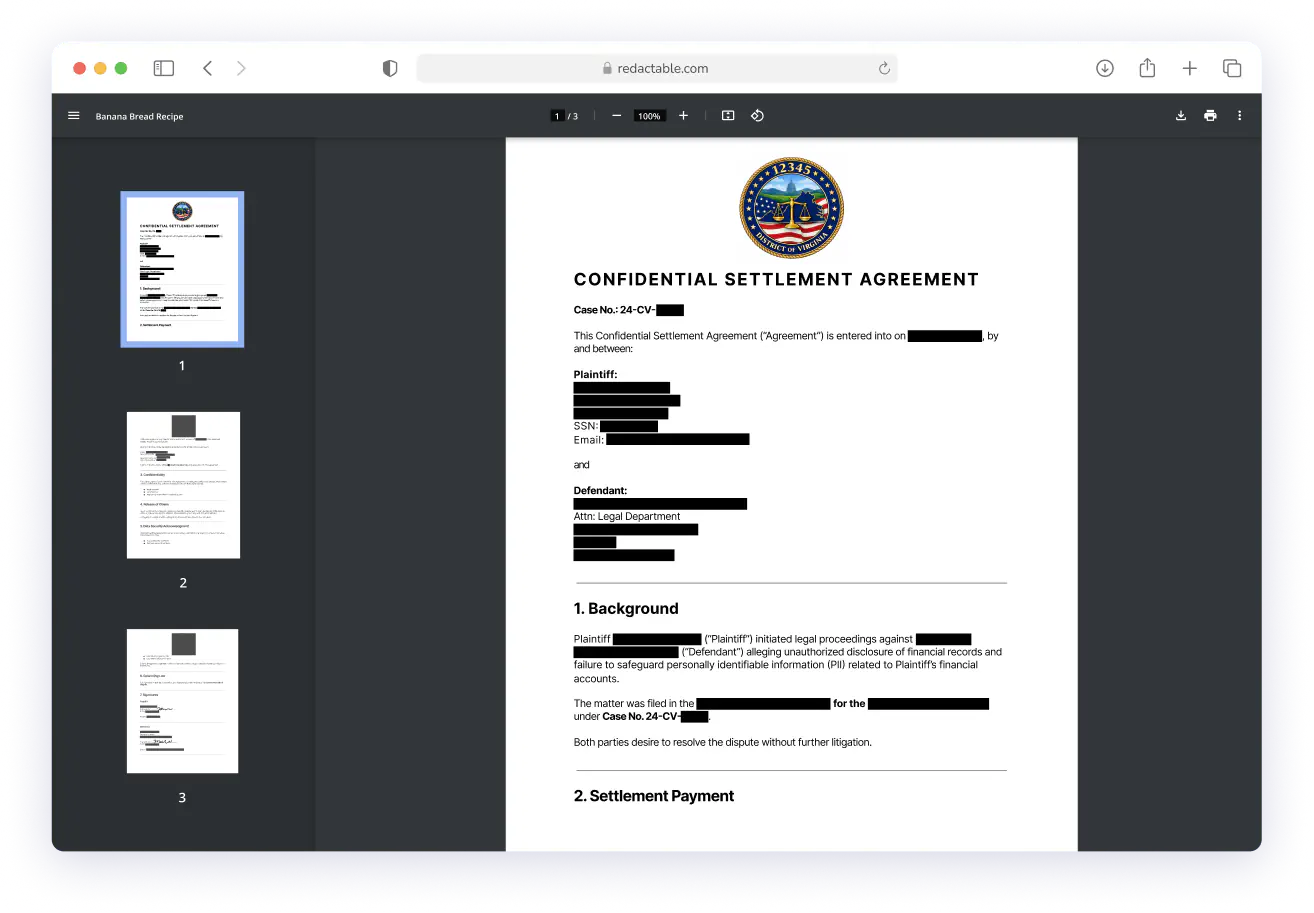
Blacking out text in Adobe doesn't delete the underlying data. Redactable permanently removes sensitive content from both the visible document and any embedded metadata or hidden document layers, so nothing can be recovered after the file leaves your office.
This helps real estate professionals meet GBLA, CCPA, GDPR, and other state privacy laws with ease and consistency.
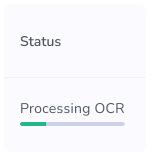
OCR for Scanned Deeds, Surveys, and Title Documents
Older property records, handwritten disclosures, and faxed loan documents present a problem for most redaction tools.
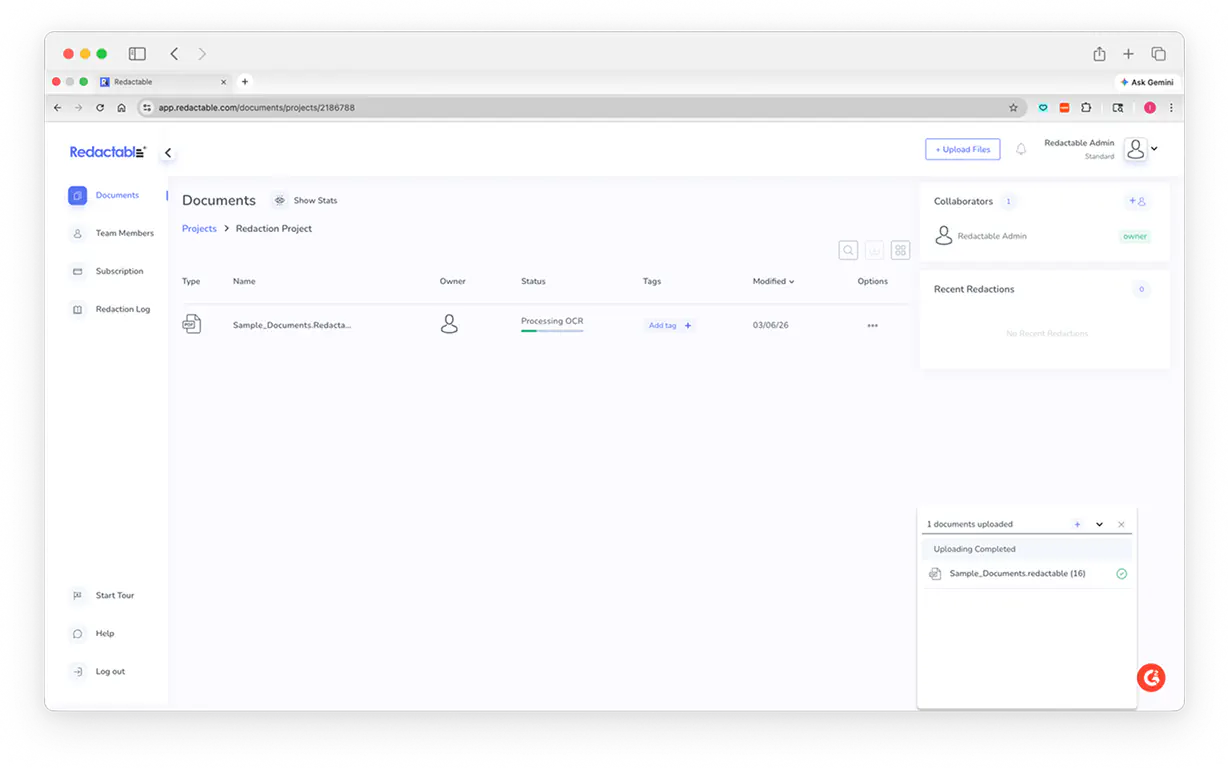
Redactable's built-in OCR converts image-based files into fully searchable documents before scanning for sensitive data, so scanned files get the same level of protection as native digital documents.
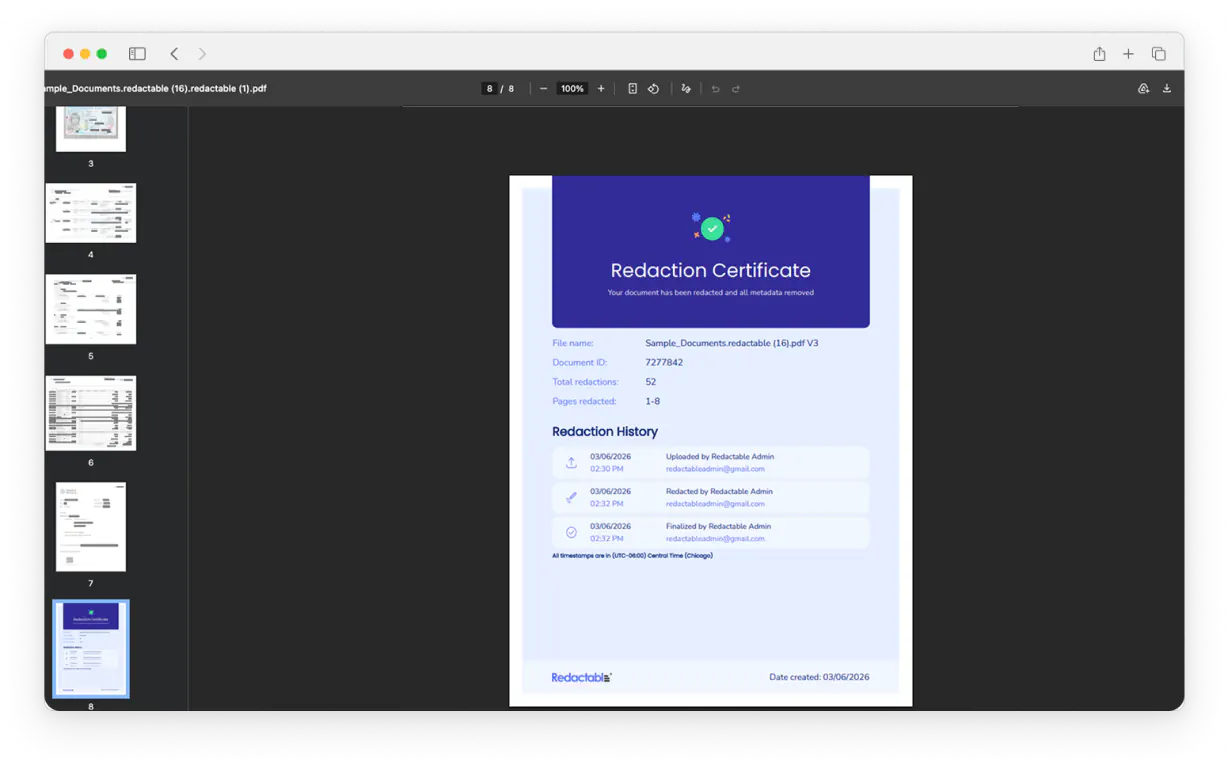
Automated Audit Trails and Redaction Certificates
Every redaction performed in Redactable, who redacted something, when, what was removed, and from which page is logged automatically.
The system generates redaction certificates for regulatory audits or legal proceedings, providing your firm with the documentation it needs to demonstrate compliance without manual recordkeeping.
Redaction Templates For Everyday Documents
Loan applications, purchase agreements, closing disclosures, and title commitments follow a predictable structure. Build a redaction template once for each document type and apply it across every new file with one click. Your team gets consistent redaction across every transaction without starting from scratch or risking the errors that come from relying on someone to remember what needs to be removed.

How Redactable Works

1
Upload contracts, loan files, title reports, disclosures, and more.

2
AI instantly identifies PII, financial data, and protected identifiers across every page.

3
You review and approve the suggested redactions.

4
Download a GLBA-compliant, permanently redacted file ready to share with clients, lenders, or third parties in minutes.
Six Ways to Protect Buyer and Seller Data in Real Estate Documents
AI-Powered Auto Redaction: Upload a contract, loan application, or closing disclosure, and our Redaction Wizard will find Social Security numbers, account numbers, signatures, and other PII across every page for you to redact. Select the flagged items you want to redact with one click, then download a new compliant file.
OCR for Scanned Property Records: Deed records, title policies, and handwritten disclosures remain sensitive even when scanned. Our AI OCR engine converts image-based files into fully searchable documents so every identifier can be found and permanently removed.
Search and Redact: Know exactly what you're looking for? Type in a name, account number, Social Security number, or property address, and we’ll find every instance across the document and flag it for redaction with metadata removal and a full audit trail.
Custom Redaction Lists: Build a list of client identifiers, internal reference numbers, or specific protected-party data and apply it automatically across any new document. We’ll do the matching and flagging so your team doesn't have to search manually.
Category Templates: Create templates for your loan applications, purchase agreements, title commitments, closing disclosures, or other common document types and apply them with one click. Templates enforce consistent redaction policies across your entire team.
Manual Redaction: Need full control? Highlight any text, image, or data point directly in the document to mark it for redaction. Fast, precise, and easy to undo before you finalize.

See What Our Clients Have to Say

No credit card required
Start redacting for free
Cancel any time

Sarah Dunbar Harper
Insurance & Legal Consultant
Redactable automatically recognizes PII including SSN and credit cards. It has easy redaction features that I can bend to blackout bars, watermarks, and the interface is easy to work with. I have been able to use Redactable to ease my redaction process. It does away with the time-consuming and painstaking exercises of redaction which if done manually poses the risk of exposing data.

Ayida Gambarova
Systems Engineer - Retail
It's AWESOME! Love it and have told my colleagues in law about it. This program saved me about 30+ hours on a project with about 1,000 pages of medical records vs. doing it "by hand" and then saved me hours when it saved the redactions and allowed me to "unredact" per a Judge's order. WONDERFUL software!! I taught myself how to use the software in about 5 minutes - no joke. So easy to use!

Philip J Berenz
Attorney at Berenz Law Network PC
Easy to use and very fast. I was able to comb through dozens of documents to redact sensitive information in a matter of minutes for $20. Can't beat that. Good customer service too. Recommend.

Eddie Hsu Pugmire
Investor
My overall experience with Redactable has been great. I can't see myself using another redacting program after using this. Redactable is so easy to use that it has become my go-to program whenever I need to redact a document. The operation is so simple that truly anyone could use it.

Ralph B.
Security & Compliance Info
Gramm-Leach-Bliley Act (GLBA)
GLBA requires real estate professionals and mortgage servicers to protect the nonpublic personal financial information they handle, such as income records, account numbers, credit data, and SSNs. Redactable permanently removes that information from every document type your team processes and logs every action for compliance documentation.
CCPA and State Privacy Laws
California's CCPA and similar laws in other states require businesses handling personal information to protect it throughout its lifecycle. Redactable's permanent redaction and metadata removal meet that standard across all file types, including scanned documents.
SOC 2 Type II Certified
Redactable is independently audited and SOC 2 Type II certified, meaning the security controls, data handling practices, and system availability your clients depend on have been verified by a third party.
HIPAA Compliant
For real estate transactions involving healthcare professionals, domestic violence advocates, or other individuals covered by HIPAA, Redactable meets the privacy and security standards required to handle protected health information when it appears in documents.
Data Privacy Framework (EU-U.S., UK, Swiss)
For international clients and transactions involving European nationals, Redactable participates in the EU-U.S., UK Extension, and Swiss-U.S. Data Privacy Frameworks. Personal data is handled in accordance with GDPR requirements throughout the redaction process.
Ready to get started?
Book a 30-minute meeting with one of our consultants to see how Redactable can work for your
organizations specific needs. Receive a custom, free quote after the call.
organizations specific needs. Receive a custom, free quote after the call.
Frequently Asked Questions
What is real estate redaction, and why does it matter for real estate transactions?
Real estate redaction is the process of permanently removing sensitive personal and financial information from property transaction documents before they are shared, filed, or archived. This includes Social Security numbers, bank account and routing numbers, income details, credit report data, and, for protected parties, property addresses and contact information. Proper redaction is required under federal laws, including the Gramm-Leach-Bliley Act, and state privacy statutes in California, Florida, and other states. Additionally, a single unredacted closing disclosure contains enough information to enable identity theft, financial fraud, or, in cases involving protected parties, physical harm.
What information needs to be redacted from real estate documents?
Real estate professionals are responsible for identifying and removing a wide range of sensitive data before sharing or storing transaction documents. Personally identifiable information includes Social Security numbers, driver's license numbers, dates of birth, and, in certain protected-party situations, full names and property addresses. Financial data requiring redaction includes bank account numbers, routing numbers, loan account identifiers, income statements, credit scores, and credit card details. In commercial real estate, confidential business information like rent rolls, investor financials, NDA-protected deal terms, and proprietary financial projections also require careful handling before documents are shared with outside parties. Beyond the visible text of documents, metadata embedded in digital files can contain sensitive details and must also be permanently removed.
What laws govern real estate redaction in the United States?
Several federal and state laws create redaction obligations for real estate professionals. The Gramm-Leach-Bliley Act (GLBA) applies to financial institutions and real estate firms that handle consumer financial data, requiring protection of nonpublic personal information throughout its lifecycle. The California Consumer Privacy Act (CCPA) covers businesses that collect or process personal data from California residents, including clients in real estate transactions. State-level address confidentiality programs require property records to shield the location and identity data of protected individuals such as domestic violence survivors, law enforcement officers, and public officials. The EU's General Data Protection Regulation (GDPR) applies to transactions involving European nationals.
How does real estate redaction apply to public land records and deeds?
Public property records (deeds, mortgage instruments, liens, and other documents recorded with the county) have their own redaction obligations that differ from those for internal transaction files. Most states have address confidentiality programs that require certain individuals to have their personal information shielded from publicly accessible land records. The challenge is that fully redacting property descriptions or legal identifiers from recorded documents can create gaps in the chain of title. Effective real estate redaction software needs to handle these documents carefully: removing the right identifiers without stripping data that title professionals need to verify ownership and complete future transactions.
Does real estate redaction apply to commercial transactions?
Yes. Commercial real estate transactions involve their own document set (purchase and sale agreements, due diligence packages, rent rolls, environmental reports, financial projections, and investor materials), each of which may contain sensitive data that shouldn't leave the transaction. The focus in commercial transactions tends to be less on individual PII and more on confidential business information: tenant identities, financial performance data, and proprietary deal terms that could cause real damage if disclosed to a competitor or unauthorized party. Redactable handles both residential and commercial document types.
Can Redactable handle scanned real estate documents?
Yes. Redactable uses built-in OCR technology to convert scanned PDFs, image-based files, and documents containing handwritten text into fully searchable formats before running its redaction detection. That means deed records, title policies, survey documents, and handwritten disclosure forms all receive the same level of coverage as native digital files.
How is Redactable different from blacking out text in Adobe?
Adobe Acrobat's basic redaction tools cover sensitive text visually but don't always permanently delete the underlying data from the document's structure or its embedded metadata. PDF metadata can contain author information, edit history, and, in some cases, recoverable text. Redactable permanently deletes sensitive content from every layer of the document (visible text, metadata, hidden layers, and embedded images), so the data cannot be recovered after redaction.
Can Redactable handle high volumes of real estate documents?
Yes. Redactable supports batch uploads of up to 100 documents, with each document containing up to 15,000 pages. Custom redaction templates let your team apply consistent policies across every document type without reviewing each file from scratch. For title companies, large brokerages, or property management firms processing hundreds of transactions a month, that means redaction stays manageable without adding headcount.
Can my team try Redactable before committing?
Yes. Redactable offers a free trial with no credit card required. Your team can upload real documents, run the AI detection, and see exactly how the platform fits your workflow before making any commitment.

Over 98% time savings with AI-powered redaction

