Most people assume that covering text with a redacting marker permanently hides it, which is standard practice in many administrative settings. On paper, it feels secure. You have a thick layer of black ink blocking the words underneath. Hold the page up to the light, and nothing shows through. For decades, that visual test was enough. In 2026, it doesn't quite cut it.
Organizations handle sensitive documents in digital formats and operate under strict regulations. A manual tool like a marker is designed for paper and does not address those realities. This gap between appearing secure and real data protection creates risk for legal teams, government offices, financial institutions, healthcare providers, and HR departments, which is why redacting markers are becoming obsolete.
The Purpose and Promise of Redacting Markers
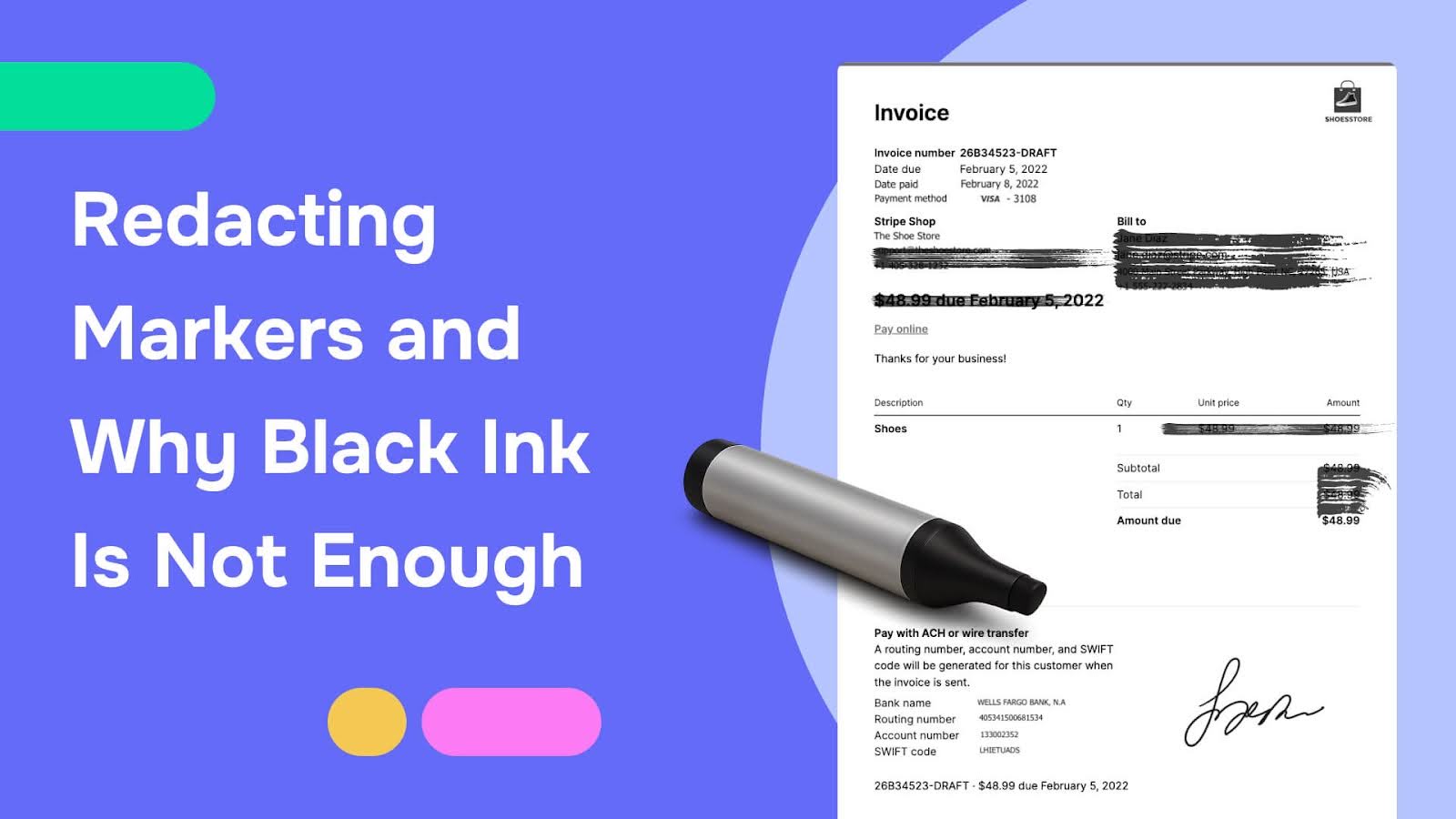
A redacting marker is a specialized, opaque felt-tip pen used to permanently cover confidential or sensitive information on physical documents. Most models are designed with a wide chisel tip to cover full lines of text quickly. Manufacturers use proprietary ink formulas intended to prevent text from being read or copied.
These tools are marketed as the best redaction markers for blocking private information such as Social Security numbers, bank account details, or client names. They work best on printed black ink and are meant to create a dense, uniform layer that cannot be seen through, even when the page is held up to light.
In many offices, redaction markers are used to remove sensitive information from documents before they are mailed, scanned, or archived. They are also used outside traditional office settings, such as obscuring labels on prescription bottles before disposal.
The Hidden Risks of Using a Redacting Pen in 2026
The idea of these markers is straightforward. Apply black ink over your original text. Your ink dries. The information disappears.
The problem is that modern risk does not stop at what the eye can see. Using redacting pens for sensitive documents is a risky process when physical tools aren't compatible with digital environments.
Legal and Compliance Exposure for Confidential Information
Many industries operate under strict privacy regulations:
- Healthcare organizations must comply with HIPAA.
- Schools manage student records under FERPA.
- Financial services firms follow complex data protection requirements.
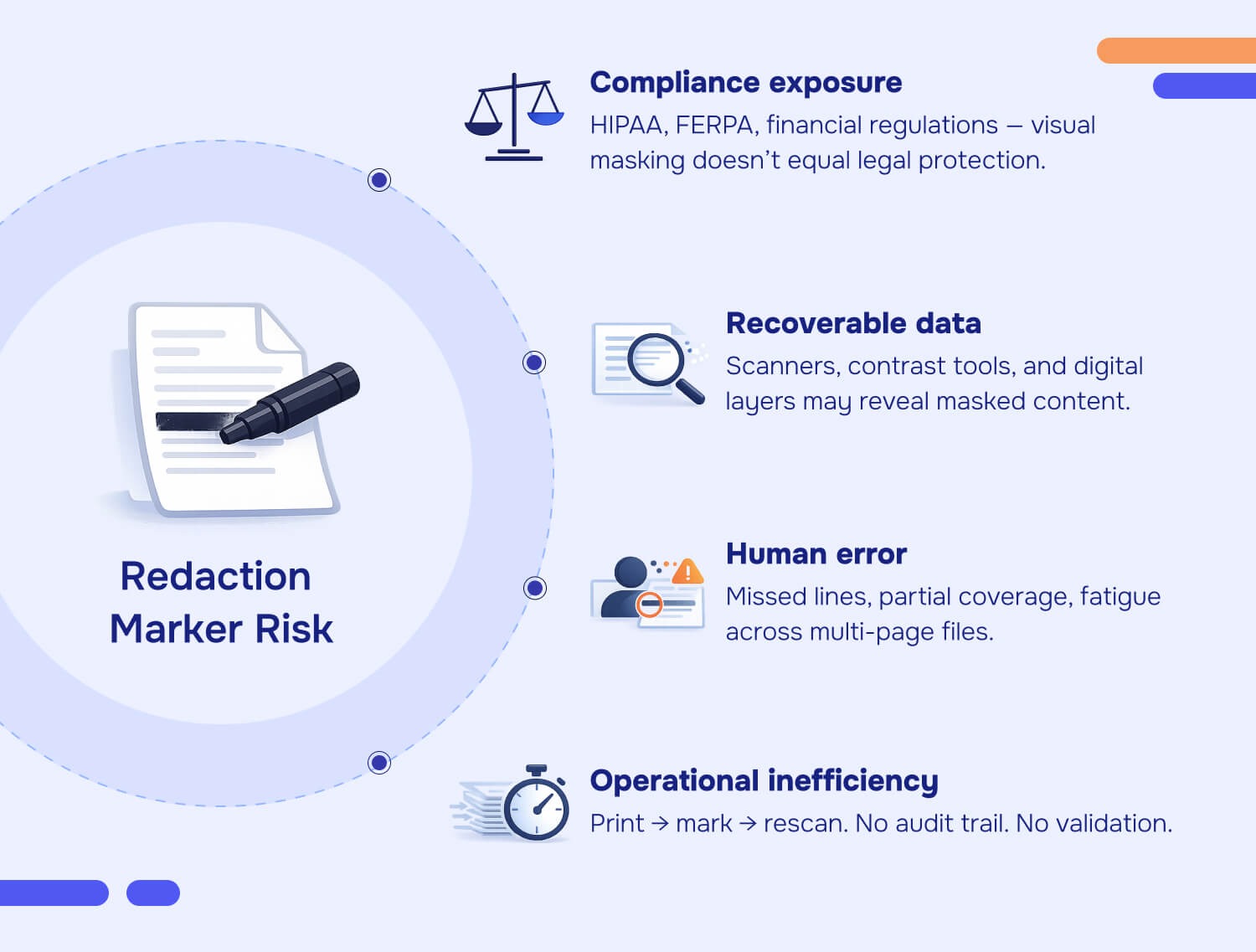
But redacting pens do not offer true protection against data recovery. They visually cover text, but they do not remove data from digital files. If a manually redacted document is later scanned and shared, underlying information may still be recoverable depending on how the document was processed.
If confidential information is exposed after redaction, the organization faces legal jeopardy. Regulatory investigations, civil litigation, and reputational damage often follow. The risks associated with redacting pens can lead to fines and costly lawsuits, especially when the failure is traced to a preventable process gap.
Human Error in the Redaction Process
In manual redaction, using markers is still a common practice in many organizations, despite the availability of digital tools. But another problem here is that redaction depends entirely on the person holding the pen, and no one can be error-free all the time.
A line missed here or a number partially covered there, or even the amount of pressure you apply, can affect how thickly the ink is applied, and suddenly, light can pass through your "redacted" information.
Volume affects people, too; on multi-page files, simple fatigue increases the chance of error. When large volumes of documents must be reviewed, the process becomes slow and repetitive. Each page requires manual scanning by eye, and there is no automated keyword search.
Even skilled professionals make mistakes under time pressure. In regulated industries, a single missed data point can create a costly problem.
Digital Recovery Risks
A redacting marker is designed to block visibility on paper, but modern technology can sometimes bypass that surface layer.
Take a high-resolution scanner, for example. They adjust brightness and contrast automatically, which could reveal information. Image enhancement software can increase contrast and detect variations in ink density. In some cases, text obscured by black ink can be partially revealed through digital manipulation.
Physical factors also matter. Thin paper may allow indentation from printed black ink to remain detectable, or glossy surfaces can reflect light differently across covered areas.
There are some digital trails you may not even think of. When a document is scanned after being marked with a redaction pen, the resulting file may also contain embedded metadata. That metadata can include hidden layers of text that were never actually removed. A physical tool simply cannot address digital layers of information.
Operational Inefficiency
Manual redaction is also time-consuming. Each document must be printed, reviewed, marked, and often rescanned. If corrections are needed, the process starts again. There is no centralized log of redactions or the identities of the redactors, and there is no built-in audit trail. You have to build those audits yourself, and nothing is automated.
For organizations handling hundreds or thousands of pages, the time cost becomes a real drain on your resources as risk increases alongside it.
Why Redaction Software Is Different
Redaction software approaches the problem at the data level rather than the surface level.
Instead of visually covering text, it permanently removes selected content from the digital file. That removal applies to visible text and embedded metadata, too. When the redaction is finalized, the deleted information cannot be recovered through simple image adjustments or file inspection.
Modern platforms use optical character recognition to make scanned documents searchable. This allows teams to locate specific names, account numbers, or phrases instantly. You also have artificial intelligence that can detect patterns associated with personal data and flag them for review.
The redaction process becomes structured and traceable, so there is less fatigue and more precision. Every action is logged, and your files don't give any sensitive information away. For teams that regularly handle sensitive documents, this protection completely changes the risk profile.

Benefits of Redaction Software Over Markers
With digital redaction, ink color and ink type are irrelevant. Digital redactions are also more convenient and cost-effective. These are the main reasons offices and practices are making the switch.
Permanent Data Removal
When a redaction is applied digitally and finalized, the selected content is excised from the file. There is no layer of black ink sitting on top of text or any hidden string in the background. The information is completely removed, including removing all metadata. From that point on, no amount of scanning or file inspection will uncover what was removed.
Reduced Human Error
AI-powered detection tools can automatically scan for common categories of confidential information. Names, phone numbers, account numbers, and similar data points can be identified across an entire document within seconds.
Users still review and approve redactions, but the initial detection does not depend solely on manual reading. This lowers the chance of missing sensitive information in long files.
Speed and Scalability
The average user can redact a 10-page document in approximately 2 minutes when using software like Redactable. That efficiency is difficult to match with a manual pen. Some digital tools also support collaborative projects in a cloud-based environment, meaning that teams can work within the same platform, rather than passing physical copies between departments.
Built-In Documentation
Redaction software can generate logs and certificates documenting what was removed and when. In regulated environments, this record supports internal audits and external inquiries. Demonstrating a consistent, technology-driven approach to redaction strengthens your organization’s compliance posture and makes it all the more appealing to clients.
Move Beyond Black Ink with Redactable
A redacting marker was designed for a paper world, but all industries are moving toward paperless environments. Those same environments are heavily regulated and still require a great deal of collaboration and security.
Continuing to rely on black ink for high-stakes redactions exposes organizations to preventable risk. Ultimately, covering text is not the same as removing data. It's time to look for software with the right features designed for security and privacy in 2026.
Redactable provides AI-powered redaction from any browser, with permanent removal of visible text and embedded metadata. Legal teams, government offices, financial institutions, and healthcare organizations use it to handle sensitive documents with greater control and traceability.
If your team still depends on manual redaction markers, this is the moment to reassess that process. Try Redactable for free and see how digital redaction changes the standard for protecting confidential information.