.png)
Redaction errors don't announce themselves. A document is filed, shared, or posted, and somewhere in it, a Social Security number, a minor's name, or a financial account number is still readable. The consequences range from a compliance violation to a data breach to a court sanction.
Getting redaction right starts with understanding the rules. Some come from federal court procedure. Others come from agency policy, state court rules, or regulations like HIPAA and FERPA. All of them matter, and none are satisfied by drawing a black box over text in a PDF.
This guide covers what the rules actually require, which information must be redacted and how, where organizations most often get it wrong, and what a compliant redaction process looks like in practice.
Understanding document redaction
Document redaction is the process of hiding or removing sensitive information from a document before sharing it with others. Its main purpose is to protect privacy and to comply with regulations for securely redacting documents.

Sensitive information, such as financial account numbers, bank account numbers, and an individual's Social Security number, must be kept out of public view. Other details, like an individual's birth name, address, phone number, and email address, might also need redaction to protect privacy and prevent identity theft.
Redaction is required for various reasons. Typically, redaction is needed when a document containing sensitive information must be transmitted or published. It’s critical to distribute the document's safe content without leaking confidential information.
Let's look at some examples:
- Court orders: When submitting documents to the court, lawyers and parties to proceedings must redact sensitive information to protect the privacy of the individuals involved. This helps prevent identity theft and other potential issues.
- Administrative proceedings: Agencies may require redaction of sensitive data before documents are made public. This is to ensure the privacy of individuals and organizations involved in the case.
- Agency proceedings: Similar to administrative proceedings, they also require redaction of sensitive information to protect privacy and maintain regulatory compliance.
In all these instances, following the rules for redacting documents securely is essential to prevent the unintentional exposure of confidential information. Redaction protects individual privacy and helps organizations avoid potential legal problems.
10 rules for redacting documents & best practices
Rule 1: Learn court rules and civil procedures for document redaction. Understand the rules that courts and agencies enforce for redacting documents to protect private information.
Rule 2: Use secure and trusted methods for redacting documents. Pick safe methods to remove private details, ensuring data security and avoiding issues.
Rule 3: Don't rely solely on word-processing programs for redaction. Ensure the revision history is inaccessible and that sensitive information is effectively protected.
Rule 4: Double-check documents to confirm sensitive information is redacted. Review your documents carefully to ensure that private information, such as financial account numbers or Social Security numbers, is not disclosed.
Rule 5: Ensure redacted information cannot be recovered electronically. Take steps to prevent hidden details from being retrieved using file recovery techniques.
Rule 6: Store redacted documents securely in encrypted storage or password-protected folders to prevent unauthorized access or disclosure of any remaining sensitive information.
Rule 7: Use a consistent redaction method throughout your document. Use the same redaction technique for a neat, organized appearance.
Rule 8: Maintain a reference list of redacted information. Keep a record of redacted details to stay organized and remember what has been hidden.
Rule 9: Train staff on secure redaction techniques and procedures. Educate employees on the most effective methods for removing private information to ensure document security.
Rule 10: Communicate with stakeholders and inform all relevant parties, such as colleagues or legal counsel, about the redacted documents and the reason for the redaction.
What the redaction rules actually require
Federal court rules are the clearest starting point for understanding redaction requirements. Two rules govern most court filings in the United States: Rule 5.2 of the Federal Rules of Civil Procedure and Rule 49.1 of the Federal Rules of Criminal Procedure. Both specify the same five categories of protected information and how each must be handled.
For Social Security numbers and taxpayer identification numbers, only the last 4 digits may appear in a filing. Dates of birth must be reduced to the year only. If a minor child is named, only the minor's initials are permitted. For home addresses, only the city and state should be listed, not the street address. Financial account numbers, including credit and debit card numbers, bank account numbers, and investment account numbers, are redacted to the last 4 digits, with the financial institution's name retained.
These redaction requirements apply to all documents filed electronically or in paper. The responsibility for redacting these identifiers rests with counsel and the filing party.
Beyond federal courts, many state court systems have adopted parallel rules. Remote public access to court records has made compliance more urgent. When public case documents are viewable online, improperly redacted information is exposed not just to the parties in a case but to anyone with internet access.
Common errors and pitfalls to avoid while redacting
Error 1: Using incorrect redaction methods. Avoid using unsafe or disallowed methods that can lead to problems.
Error 2: Inadequate redaction of image details. Expertly redact images to prevent the exposure of hidden text.
Error 3: Not redacting all instances of the same data. Ensure all occurrences of private details are removed.
Error 4: Assuming hidden text is secure without verifying. Confirm the safety of redacted text rather than assuming it's secure.
Error 5: Failing to train staff on redaction requirements. Provide training for employees on redaction techniques to comply with rules and regulations.
Using a reliable redaction solution like Redactable can help you avoid these common errors by providing a secure, efficient, and automatic way to redact all instances of sensitive information. With Redactable, you can ensure compliance, protect privacy, and maintain the highest standards of document security.
The black box problem: why coverage isn't redaction
This is the most common misconception about redactions, and it creates real legal exposure.
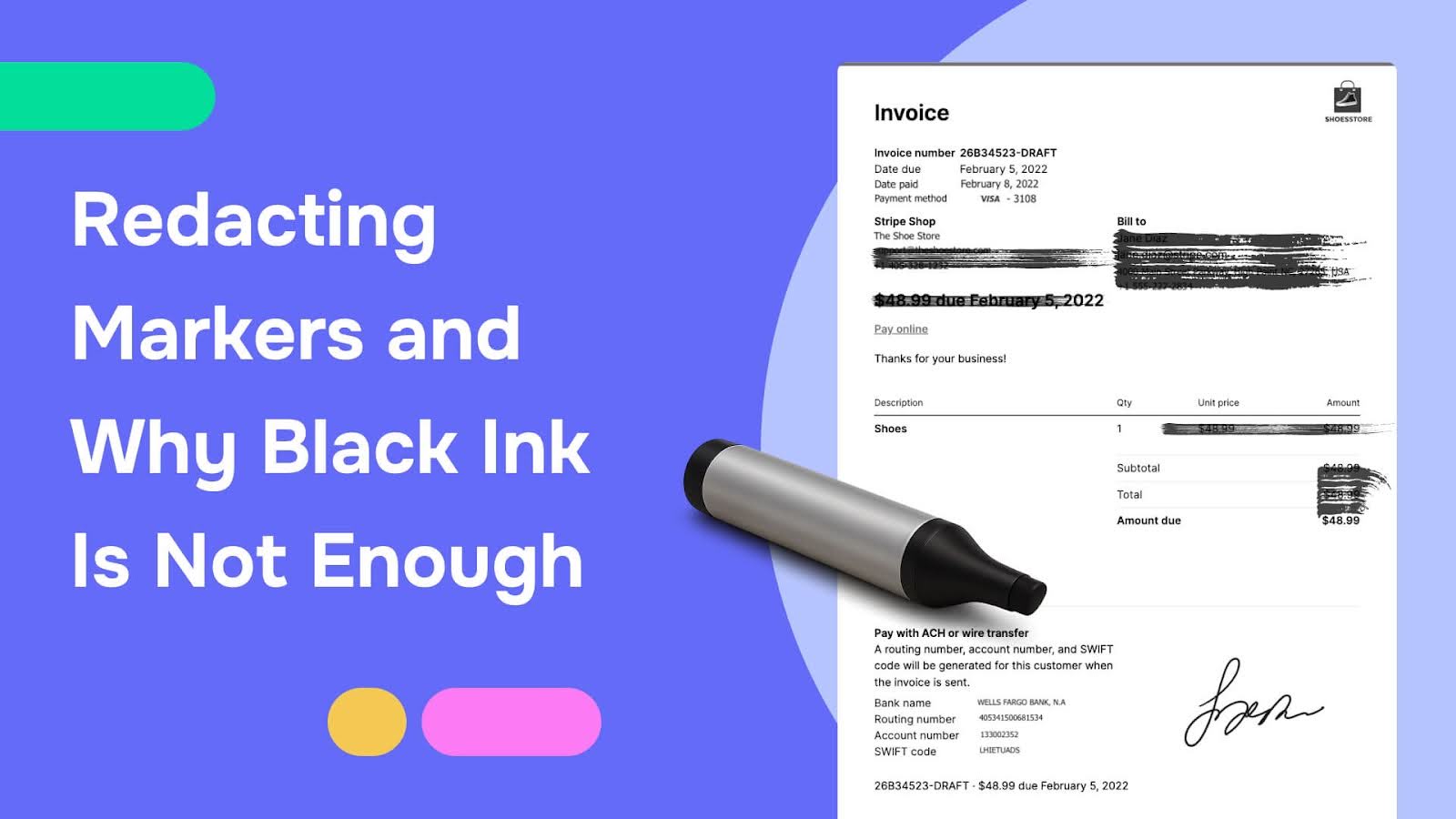
A black box applied over text in a standard PDF tool looks like redaction. In many cases, it isn't. The visual overlay sits on top of the original content without removing it. Anyone who selects the text below, copies it to the clipboard, or processes the file with a text-extraction tool can read what was supposed to be hidden.
The same problem applies to changing font color to white, highlighting text with an opaque shape, and using comment or annotation tools to cover content. All of these create a visual effect but do not permanently remove data.
Word processor metadata compounds the problem. Every Word document carries a revision history embedded in the file. That history records deleted content, prior versions, and edits even after the file is re-saved. Converting a Word file to PDF doesn't automatically strip this history. A document that looks clean in a PDF viewer may still contain retrievable content in its underlying structure.
True redaction requires software that removes content from the document at the data level. That means eliminating the sensitive text from the content stream, stripping metadata, and removing any OCR layer that may contain a readable version of the obscured content. Redactable processes all of these layers, so what's removed stays removed.
Redaction requirements across industries
Document redaction is vital for organizations across several industries, including legal, financial, medical, and educational fields. Each of these industries handles sensitive information daily, making secure redaction essential.
1. Legal sector
In legal proceedings, redaction protects the identities of witnesses and victims, as well as sensitive case details. It prevents the accidental disclosure of confidential information, which could compromise the integrity of the judicial process.
Correctly redacting documents in the legal field is crucial to upholding the privacy rights of those involved and maintaining the confidentiality of the legal process.
2. Financial sector
In the financial industry, redacting documents helps to safeguard customers' account numbers, personal information, and other sensitive financial data.
Banks, credit card companies, and other institutions handle vast amounts of private information, and removing sensitive information is essential to prevent identity theft and maintain trust between these organizations and their customers.
By implementing secure redaction processes, financial firms can protect their clients' data from unauthorized access and potential misuse.
3. Medical sector
In the medical field, redaction is critical for preserving patient privacy and adhering to regulations such as the Health Insurance Portability and Accountability Act (HIPAA).
Healthcare providers, hospitals, and insurance companies manage confidential patient information, including medical histories, diagnoses, and treatment plans.
Proper redaction ensures that patient data remains confidential and that medical professionals comply with legal requirements to protect patient privacy.
4. Educational sector
Educational institutions, such as schools and universities, also handle sensitive information like student records, transcripts, and personal data.
The Family Educational Rights and Privacy Act (FERPA) mandates that educational institutions protect the privacy of students' educational records. Redaction practices help schools maintain compliance with FERPA and other applicable regulations, verifying that students' personal information remains private and secure.
Whatever industry you’re in, trust Redactable as the best solution to keep your sensitive data safe and secure.
Read our complete guide (including video tutorials) on how to redact a PDF
The consequences of inadequate redaction
Failing to redact documents securely can lead to a variety of severe consequences, including:
Legal penalties: Noncompliance with regulations such as HIPAA and FERPA may result in fines, lawsuits, or other legal actions against your organization.
Loss of trust: Inadequate redaction can erode the trust between an organization and its clients or stakeholders, potentially leading to lost business or damaged relationships.
Damage to reputation: Exposure of sensitive information can harm an organization's reputation, making it difficult to rebuild credibility and regain public trust.
Securely redacting documents is crucial across various industries. It ensures the confidentiality of sensitive information and helps organizations maintain compliance with relevant regulations.
How Redactable handles the redaction process
Do you want to keep your documents safe? Redactable is the solution you need.
Redactable is an AI-powered redaction platform built for legal, compliance, and records teams that need permanent, verifiable results. Unlike PDF editors that layer visual overlays on top of document content, Redactable removes sensitive data from the content stream, the metadata, the OCR layer, and any embedded objects.

Key capabilities:
- Easy setup at any scale — From task management to setting up a review process, we make it a breeze to set up and work on large-scale redaction projects.
- AI-powered auto-detection — Redactable's built-in AI identifies sensitive information automatically, including PII, PHI, financial account numbers, and custom-defined patterns, across hundreds of pages in minutes.
- Permanent removal — Data is deleted from the document at the file level. Redacted information cannot be retrieved through copy-paste, text extraction, or metadata review.
- Document scrubbing — Redactable removes metadata and hidden document elements to ensure redaction is complete and cannot be reversed.
- Redaction certificates — Every redaction session generates an automatic certificate documenting who redacted what and when, providing an audit trail for compliance purposes.
- Cloud collaboration — Teams can work on redaction projects simultaneously using Redactable's cloud-based platform, with role-based access controls.
- Integrations — Import documents directly from Box, Dropbox, and other cloud storage services.
Keep sensitive information out of the public record
When court records are publicly accessible online, a missed Social Security number or an unredacted financial account is an exposure event. The rules for redacting documents exist because real people are harmed when that information gets out.
Redactable gives legal teams, compliance officers, and records staff a process that actually removes data rather than covering it. With AI-powered detection, permanent removal across all document layers, and redaction certificates for regulatory compliance, it removes the guesswork from a process that doesn't leave room for it.
If you're looking for an efficient and secure method to redact sensitive information from your documents, don't hesitate to try Redactable for free today or Book a Demo.