Every year, thousands of civil suits turn on a company's ability to prove it didn't destroy evidence. As Slack threads, shared drives, personal email accounts, and text messages absorb more of a company's daily communication, the volume of information that could become evidence keeps growing right along with it.
A litigation hold is a directive that suspends an organization's normal document destruction schedule the moment a lawsuit becomes reasonably likely, whether or not a case has actually been filed yet. Get the timing wrong, and the consequences aren't limited to losing evidence. Courts have sanctioned companies, dismissed defenses, and entered default judgments over litigation holds that were issued late, poorly worded, or never enforced.
This guide covers what a litigation hold actually requires, who it applies to, and where document redaction fits into the process once the hold is in place.
What Is a Litigation Hold?
A litigation hold is a formal directive instructing an organization and its employees to preserve physical documents, communications, and electronically stored information that may be relevant to a pending or reasonably anticipated lawsuit. It overrides any standing document retention or deletion policy for as long as the hold remains active.
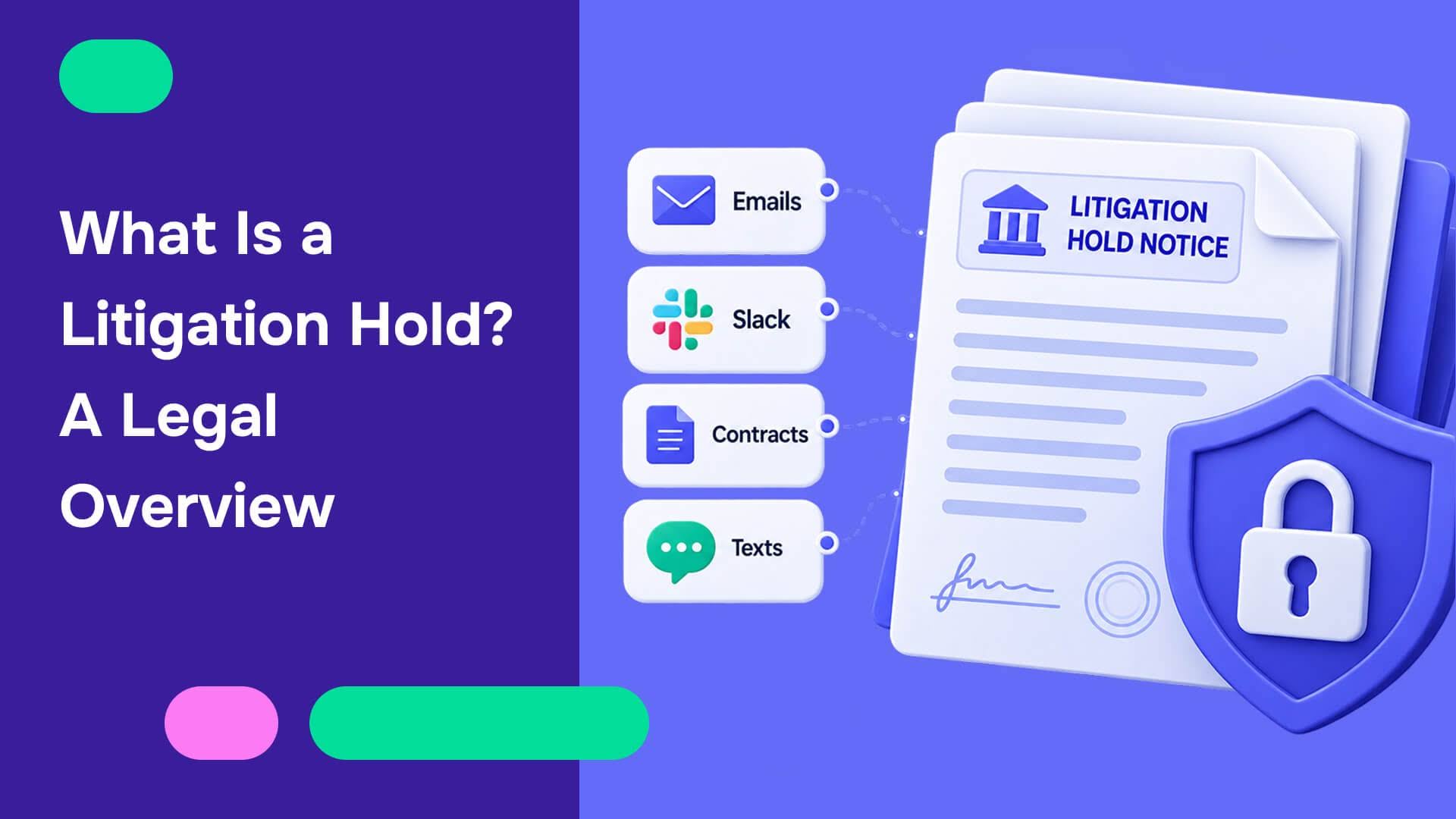
The hold applies broadly. It covers paper records and electronically stored information, including emails, text messages, spreadsheets, contracts, Slack and Teams messages, voicemails, and anything stored on a personal device that relates to company business. The person managing a matter doesn't get to decide which of these formats is less important than the others. If a document could be relevant to the dispute, it gets preserved in its original, unaltered form until the hold is lifted.
Legal Hold vs. Litigation Hold: Same Thing?
Some resources describe a legal hold as a broader, earlier-stage preservation step and a litigation hold as the narrower version that kicks in once a suit is imminent. In practice, courts and legal counsel use the terms interchangeably across court guidance and in-house counsel resources. Both are directives to preserve evidence, triggered by anticipated or pending litigation, regardless of which term an organization's policy uses.
Some organizations use legal hold as an umbrella term covering internal investigations or regulatory inquiries that haven't yet become litigation, while reserving litigation hold specifically for active or imminent lawsuits. Either way, the preservation duty works the same, and the difference lies only in internal naming conventions.
When Litigation Is Reasonably Anticipated
The duty to preserve evidence doesn't wait for a complaint to get filed. It begins the moment an organization reasonably anticipates litigation, a standard courts have applied broadly and somewhat unpredictably.
Common triggering events include:
- A demand letter or a preservation letter from opposing counsel
- Service of a formal complaint or subpoena
- An EEOC charge of discrimination or a similar administrative filing
- Internal knowledge of an incident serious enough that a lawsuit is a credible possibility, even without outside contact yet
That last event trips up many organizations. The reasonable anticipation standard doesn't require a lawyer's letter to apply. If a general counsel's office knows about a workplace injury, data breach, or a terminated employee's threat to sue, the duty to preserve may already be running, whether or not anyone outside the company has said the word "lawsuit" yet.
The modern litigation hold owes much to a 2003 ruling in Zubulake v. UBS Warburg by U.S. District Judge Shira Scheindlin, which established that a party must suspend its routine destruction process and issue a formal hold once litigation is anticipated. That decision still shapes how courts evaluate preservation obligations today.
What a Litigation Hold Covers: Custodians, ESI, and the Duty to Preserve
A litigation hold identifies who must preserve information and what they must preserve.
The who is a company's custodians, meaning employees or individuals who possess documents, communications, or data potentially relevant to the dispute. Custodians aren't limited to executives or the people directly named in a complaint. A mid-level manager who exchanged a handful of emails about the disputed issue is a custodian just as much as the person being sued.
The what is electronically stored information, or ESI, alongside physical records. ESI covers email, text messages, chat logs, shared drive files, database entries, voicemail, metadata, and anything else generated or stored electronically that could bear on the dispute. Physical documents, printed reports, and handwritten notes are subject to the same obligation.
The underlying duty to preserve evidence comes from the common law. Once litigation is reasonably anticipated, a party has to take reasonable steps to prevent the loss of relevant information. Rule 37(e) of the Federal Rules of Civil Procedure governs what a court may do when electronically stored information is lost because a party failed to take reasonable steps. Knowing which is which changes where an organization should look when building a hold policy. Preservation obligations arise from case law and general discovery principles, whereas Rule 37(e) applies only if something goes wrong.
Reasonable steps doesn't mean perfection. Courts recognize that the volume of ESI generated by any active organization makes flawless preservation unrealistic. What gets scrutinized is whether the organization made a good-faith, documented effort proportional to what a reasonable company in its position would do.
The Litigation Hold Notice and Process
The litigation hold process generally starts with scoping. Legal counsel, often working with outside litigation counsel on complex matters, identifies which employees and departments are likely to hold relevant information based on the nature of the claim.
Once a hold is triggered, the mechanism for enforcing it is the litigation hold notice. This is a written document, typically issued by general counsel or outside litigation counsel, sent to all identified custodians.
An effective notice covers:
- A description of the dispute and the issues involved
- The categories of records and data covered
- The relevant time period
- Clear instructions to stop deleting, altering, or discarding covered material
- How the custodian should preserve and, later, produce the material
- A request for written acknowledgment that the custodian received and understood the notice
IT departments also need a copy, so automatic deletion schedules and backup rotation policies get suspended for anything covered by the hold. HR should be looped in as well, since an employee who leaves the company mid-hold still needs their accounts and files preserved during offboarding.
In-house counsel guidance on legal holds consistently identifies follow-up as the step most often skipped. It’s important to confirm that custodians actually understand their obligations, check in periodically for as long as the matter is active, and document every step taken. That documentation becomes the organization's defense if a court later asks whether reasonable steps were taken.
A litigation hold stays in effect until the matter is fully resolved, including any appeals, and counsel formally releases the hold. Only then do normal document retention and deletion policies resume for the previously covered records.
What Happens When a Litigation Hold Fails
When relevant evidence is lost because an organization failed to preserve it and it can't be recovered or replaced by other means, courts can respond in several ways, depending on how serious the failure was and whether it appears intentional.
On the lower end, a judge can order measures to cure the prejudice the other side suffered, things like reopening discovery or narrowing what the negligent party can argue at trial. On the higher end, once a court finds that a party acted with intent to deprive the other side of the evidence, sanctions escalate to an adverse inference instruction (telling the jury it can assume the missing evidence was unfavorable), exclusion of evidence, or, in the most severe cases, dismissal of claims or a default judgment.
In the Washington federal court ruling of Knickerbocker v. Corinthian Colleges, a for-profit education company failed to place a litigation hold after being sued by former employees, resulting in the deletion of emails relevant to the case. The court sanctioned the company $25,000 and ordered it to cover the plaintiffs' attorney's fees, on top of the cost of hiring outside vendors to try to recover what had already been deleted.
A negligent failure to preserve evidence, without any intent to hide it, can still result in monetary sanctions and a loss of credibility with the court. The safest position treats every reasonably anticipated dispute as if a court will eventually ask what steps were taken to protect the evidence, because eventually, one might.
Litigation Holds and Document Redaction: Where They Intersect
A litigation hold is all about preservation. Nothing relevant gets altered, deleted, or destroyed. Redaction is about disclosure. Sensitive information is permanently removed from a document copy before it leaves the organization's control. Redacting before a hold is properly documented, or treating a redacted copy as a substitute for the preserved original, creates exactly the kind of preservation failure that leads to sanctions.
Original, unaltered documents should be preserved for as long as the hold is active. Redaction happens on copies, generated specifically for review, production, or disclosure, once counsel has determined what needs to be shared and what needs to be withheld or masked. A few things separate a defensible redaction from one that creates new risk:
- Permanent removal: A redacting marker that only covers text visually can leave the underlying data recoverable, which defeats the purpose of the redaction and can expose privileged or protected material during a production that was supposed to protect it.
- Metadata handled by stage: A document under a litigation hold may need its metadata preserved intact, including creation dates, author fields, and edit history, since the metadata itself may be relevant evidence. Once the same document is cleared for production, that metadata typically needs to come out before it goes to opposing counsel or a regulator.
- A defensible audit trail: Redactable's audit trail for every redaction action gives legal teams a record of exactly what was changed, when, and by whom, which matters when a court or opposing counsel questions how a production copy was prepared.
- A connected privilege review: For documents where privilege is the concern rather than personal data, the same review process that produces redactions typically feeds directly into a privilege log.
Once documents clear the hold and move toward production, Redactable permanently removes personally identifiable information, privileged content, and hidden metadata from the copies, leaving your organization with every action logged automatically as it happens.
Moving From Preservation to Production with Redactable
A litigation hold exists to answer the question: Can this organization prove it didn't destroy evidence it was supposed to keep? Getting the trigger, notice, and follow-through right protects against sanctions that can cost far more than the underlying case. None of that changes what happens once documents move toward production. At that point, the obligation shifts from preserving everything to disclosing only what's required.
Explore Redactable for legal teams to see how legal and litigation support use it across discovery, subpoena responses, and case file production.
.jpg)