FOIA Redaction
State and local government FOIA requests
Automated FOIA redaction software for state and local agencies
Securely protect sensitive information and ensure compliance with state and local FOIA regulations using Redactable’s AI-powered redaction software.
Freedom of Information laws exist at both the federal and state levels, granting citizens the right to access public records. These laws are designed to promote transparency and accountability within government. However, state and local agencies face the challenge of providing access to public records while protecting sensitive information, including personal data, law enforcement details, and confidential business information.
Redactable’s automated FOIA redaction platform helps agencies comply with state and local disclosure requirements, safeguard confidential information, and maintain public trust. By streamlining the redaction process, Redactable allows agencies to efficiently respond to requests while minimizing the risk of accidental disclosure.
How state and local FOIA requests work: process, timelines, and limitations
Submitting a state or local FOIA request usually begins with a written application. The requester describes the records they are seeking, sometimes including specific dates, departments, or keywords. Requirements for submission formats vary by state, and some agencies provide standardized request forms.
Once received, the agency reviews the request to:
- Verify that the records exist
- Determine whether any exemptions apply
- Assess the amount of information that can be safely disclosed
State FOIA laws typically provide response deadlines ranging from 5 to 30 business days, depending on jurisdiction. Extensions may be granted for large, complex, or multi-departmental requests. Agencies may also charge reasonable fees to cover the costs of searching, copying, or redacting records.
Even when a request is approved, documents may contain sensitive information that cannot be publicly disclosed. Redaction ensures these details are permanently removed, meeting transparency requirements without compromising privacy, security, or public safety.
Common FOIA exemptions at the state and local level
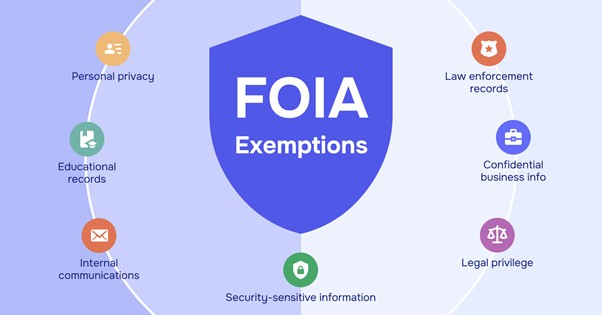
State and local FOIA laws allow agencies to withhold certain information under defined exemptions. While specific categories vary across jurisdictions, some of the most common include:
Personal privacy: Social Security numbers, medical records, home addresses, driver’s license numbers, and other personally identifiable information (PII).
Law enforcement records: Details of ongoing investigations, confidential informant identities, internal case notes, arrest records under seal, and other sensitive law enforcement content.
Internal agency communications: Emails, memos, and other internal deliberative documents that support decision-making but are not intended for public release.
Confidential business information: Proprietary data, trade secrets, contract details, financial statements, and intellectual property submitted by private companies.
Security-sensitive information: Data regarding emergency response plans, critical infrastructure, or public safety operations that could compromise security if disclosed.
Educational records: Student records, grades, and other information protected under state privacy laws and federal regulations like FERPA.
Personal privacy
Social Security numbers, medical records, home addresses, driver’s license numbers, and other personally identifiable information (PII).
Law enforcement records
Details of ongoing investigations, confidential informant identities, internal case notes, arrest records under seal, and other sensitive law enforcement content.
Legal and attorney-client privileged information
Internal legal communications or documents prepared for litigation that are protected from disclosure.
Agencies are required to redact all exempted information before releasing documents to ensure compliance. Redactable automates this process, applying consistent and permanent redaction across all relevant data.
Permanent redaction vs visual hiding
Traditional redaction methods, such as blacking out text in PDFs or using white boxes, often leave data recoverable. Hidden metadata, transparent layers, and copy-paste vulnerabilities can expose sensitive information.
Redactable completely removes sensitive information, including:
- Text and numbers
- Metadata and hidden layers
- Transparent or covered objects
- Embedded images, charts, and signatures
This ensures permanent compliance with FOIA laws, eliminating the risk of accidental disclosure.
Automated FOIA redaction software for state and local agencies
Securely protect sensitive information and ensure compliance with state and local FOIA regulations using Redactable’s AI-powered redaction software.
Freedom of Information laws exist at both the federal and state levels, granting citizens the right to access public records. These laws are designed to promote transparency and accountability within government. However, state and local agencies face the challenge of providing access to public records while protecting sensitive information, including personal data, law enforcement details, and confidential business information.
Redactable’s automated FOIA redaction platform helps agencies comply with state and local disclosure requirements, safeguard confidential information, and maintain public trust. By streamlining the redaction process, Redactable allows agencies to efficiently respond to requests while minimizing the risk of accidental disclosure.
How state and local FOIA requests work: process, timelines, and limitations
Submitting a state or local FOIA request usually begins with a written application. The requester describes the records they are seeking, sometimes including specific dates, departments, or keywords. Requirements for submission formats vary by state, and some agencies provide standardized request forms.
Once received, the agency reviews the request to:
- Verify that the records exist
- Determine whether any exemptions apply
- Assess the amount of information that can be safely disclosed
State FOIA laws typically provide response deadlines ranging from 5 to 30 business days, depending on jurisdiction. Extensions may be granted for large, complex, or multi-departmental requests. Agencies may also charge reasonable fees to cover the costs of searching, copying, or redacting records.
Even when a request is approved, documents may contain sensitive information that cannot be publicly disclosed. Redaction ensures these details are permanently removed, meeting transparency requirements without compromising privacy, security, or public safety.
Common FOIA exemptions at the state and local level

State and local FOIA laws allow agencies to withhold certain information under defined exemptions. While specific categories vary across jurisdictions, some of the most common include:
Personal privacy: Social Security numbers, medical records, home addresses, driver’s license numbers, and other personally identifiable information (PII).
Law enforcement records: Details of ongoing investigations, confidential informant identities, internal case notes, arrest records under seal, and other sensitive law enforcement content.
Internal agency communications: Emails, memos, and other internal deliberative documents that support decision-making but are not intended for public release.
Confidential business information: Proprietary data, trade secrets, contract details, financial statements, and intellectual property submitted by private companies.
Security-sensitive information: Data regarding emergency response plans, critical infrastructure, or public safety operations that could compromise security if disclosed.
Educational records: Student records, grades, and other information protected under state privacy laws and federal regulations like FERPA.
Personal privacy
Social Security numbers, medical records, home addresses, driver’s license numbers, and other personally identifiable information (PII).
Law enforcement records
Details of ongoing investigations, confidential informant identities, internal case notes, arrest records under seal, and other sensitive law enforcement content.
Legal and attorney-client privileged information
Internal legal communications or documents prepared for litigation that are protected from disclosure.
Agencies are required to redact all exempted information before releasing documents to ensure compliance. Redactable automates this process, applying consistent and permanent redaction across all relevant data.
Permanent redaction vs visual hiding
Traditional redaction methods, such as blacking out text in PDFs or using white boxes, often leave data recoverable. Hidden metadata, transparent layers, and copy-paste vulnerabilities can expose sensitive information.
Redactable completely removes sensitive information, including:
- Text and numbers
- Metadata and hidden layers
- Transparent or covered objects
- Embedded images, charts, and signatures
This ensures permanent compliance with FOIA laws, eliminating the risk of accidental disclosure.
Interested in learning more?
How to perform state and local FOIA redaction
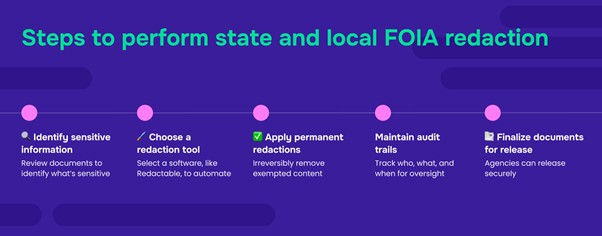
Performing FOIA redaction correctly requires a structured approach and reliable tools. Key steps include:
1. Identify sensitive information
Agencies must carefully review documents to determine what constitutes sensitive data. This may include personal identifiers, law enforcement details, confidential business information, and security-sensitive data. Misidentifying or overlooking information can lead to non-compliance or legal exposure.
2. Choose a redaction tool
Manual redaction methods are labor-intensive, error-prone, and time-consuming. Automated redaction platforms, such as Redactable, streamline the process, improve accuracy, and enable agencies to handle large volumes of records efficiently.
3. Apply permanent redactions
Once sensitive information is identified, Redactable uses AI-powered detection to permanently remove it. The system applies FOIA exemption codes, tracks all actions, and ensures that redacted content cannot be recovered.
4. Maintain audit trails
Redactable logs every action taken on a document, including who applied redactions, when they were applied, and why. This is essential for accountability and legal compliance.
5. Finalize documents for release
After redaction is complete, agencies can finalize documents with confidence. Redactable generates redaction certificates and detailed reports, ensuring full regulatory compliance before records are shared with requesters.
Redactable’s AI-powered FOIA redaction software

Redactable offers a comprehensive solution for state and local agencies to manage FOIA requests efficiently, securely, and consistently.
Key features and benefits:
- Custom exemption codes – track exempted information using FOIA or state-specific exemption labels
- Batch document upload – process and OCR multiple files simultaneously to save time
- AI-driven detection – automatically identify PII, financial information, law enforcement content, and other sensitive records
- Detailed audit logs – maintain a complete record of redaction activities for compliance purposes
- Secure and complete redaction – permanently remove hidden text, metadata, and embedded objects
- Real-time team collaboration – multiple users can simultaneously redact and review documents with role-based permissions
- Privilege log generation – automatically create reports for attorney-client or work-product protected content
- Draft redactions and review workflows – preview redactions before finalization, ensuring accuracy and compliance
Redactable is ideal for municipalities, public universities, law enforcement agencies, public health departments, and other state or local organizations that process FOIA requests.
How to perform state and local FOIA redaction

Performing FOIA redaction correctly requires a structured approach and reliable tools. Key steps include:
1. Identify sensitive information
Agencies must carefully review documents to determine what constitutes sensitive data. This may include personal identifiers, law enforcement details, confidential business information, and security-sensitive data. Misidentifying or overlooking information can lead to non-compliance or legal exposure.
2. Choose a redaction tool
Manual redaction methods are labor-intensive, error-prone, and time-consuming. Automated redaction platforms, such as Redactable, streamline the process, improve accuracy, and enable agencies to handle large volumes of records efficiently.
3. Apply permanent redactions
Once sensitive information is identified, Redactable uses AI-powered detection to permanently remove it. The system applies FOIA exemption codes, tracks all actions, and ensures that redacted content cannot be recovered.
4. Maintain audit trails
Redactable logs every action taken on a document, including who applied redactions, when they were applied, and why. This is essential for accountability and legal compliance.
5. Finalize documents for release
After redaction is complete, agencies can finalize documents with confidence. Redactable generates redaction certificates and detailed reports, ensuring full regulatory compliance before records are shared with requesters.
Redactable’s AI-powered FOIA redaction software

Redactable offers a comprehensive solution for state and local agencies to manage FOIA requests efficiently, securely, and consistently.
Key features and benefits:
- Custom exemption codes – track exempted information using FOIA or state-specific exemption labels
- Batch document upload – process and OCR multiple files simultaneously to save time
- AI-driven detection – automatically identify PII, financial information, law enforcement content, and other sensitive records
- Detailed audit logs – maintain a complete record of redaction activities for compliance purposes
- Secure and complete redaction – permanently remove hidden text, metadata, and embedded objects
- Real-time team collaboration – multiple users can simultaneously redact and review documents with role-based permissions
- Privilege log generation – automatically create reports for attorney-client or work-product protected content
- Draft redactions and review workflows – preview redactions before finalization, ensuring accuracy and compliance
Redactable is ideal for municipalities, public universities, law enforcement agencies, public health departments, and other state or local organizations that process FOIA requests.
Frequently asked questions
Requesters submit a formal written application. The agency verifies the records and applies necessary redactions before releasing the documents.
Sensitive personal data, law enforcement information, internal communications, confidential business data, legal and privileged records, and security-sensitive information must be redacted.
Redactable automates the identification and removal of sensitive data, applies exemption codes, maintains full audit trails, and provides redaction certificates to demonstrate compliance with state and local FOIA laws.
Yes. Redactable is designed for batch processing and can efficiently manage hundreds or thousands of documents across multiple requests.
No. Redactable ensures permanent redaction by completely removing sensitive content, including hidden data and metadata, guaranteeing full compliance.