Fast, Redaction for Insurance Without the Risk
Protect policyholder data in every claim file, medical record, and investigation report with AI-powered redaction software built for insurance professionals.

AI-powered precision redacts sensitive information instantly
Reduce human error and redaction time by up to 98%
SOC 2 Type II and HIPAA-compliant platform







.svg)
Results for Insurance Teams That Use Redactable
.svg)

The Real Challenges With Insurance Document Redaction

Claims Files Are Too Complex to Review Page by Page

Policyholder Data Moves Through Too Many Hands

Most Redaction Tools Can't Read Scanned Insurance Files

Claims Processing Deadlines Leave No Room for Manual Redaction

One Missed Identifier Can Trigger a Regulatory Investigation
A single liability claim can pull together medical records, police reports, witness statements, and financial records, all containing sensitive personal data belonging to multiple individuals. When claims teams are managing hundreds of open files, manually reviewing every page before disclosure isn't a realistic option.
Insurance documents don't stay inside your organization. Claim files travel to independent adjusters, reinsurers, outside counsel, and state regulators. Every handoff creates a potential data breach if sensitive personal data hasn't been permanently removed before the file leaves your system.
Insurance operations run on paper converted to digital. Faxed medical certifications, scanned intake forms, handwritten adjuster notes, and photographed accident reports all arrive as image-based files. Standard redaction tools skip right over the sensitive data inside them because they can't read what OCR hasn't processed first.
Regulators, opposing counsel, and reinsurers don't wait. When a production deadline hits, the pressure to move fast is exactly when human error during redaction creates compliance violations. Insurance companies need a redaction process that keeps pace with claims volume without cutting corners on data security.
State insurance departments and federal regulators treat improper disclosure of policyholder data seriously. A single unredacted Social Security number or medical record in a produced document can open your organization to fines, legal consequences, and loss of customer trust.

Why Insurance Companies Choose Redactable
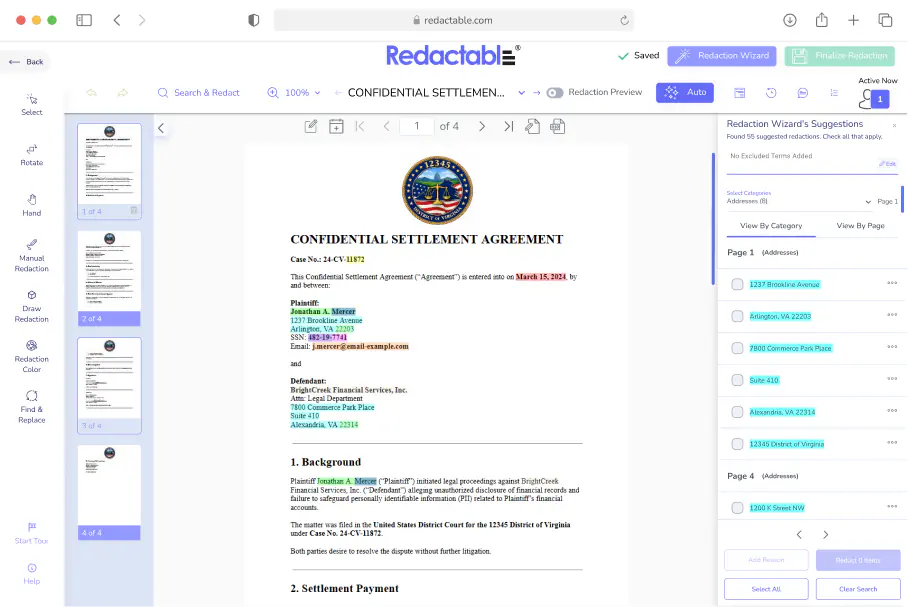


Automatic Detection of Policyholder PII Across Every Document Type
Redactable's AI scans claim files, policy documents, investigation reports, and medical records and flags what matters most, including Social Security numbers, dates of birth, home addresses, bank account details, policy numbers, and claimant financial data.
Your team reviews what's flagged and confirms. The AI does the rest.
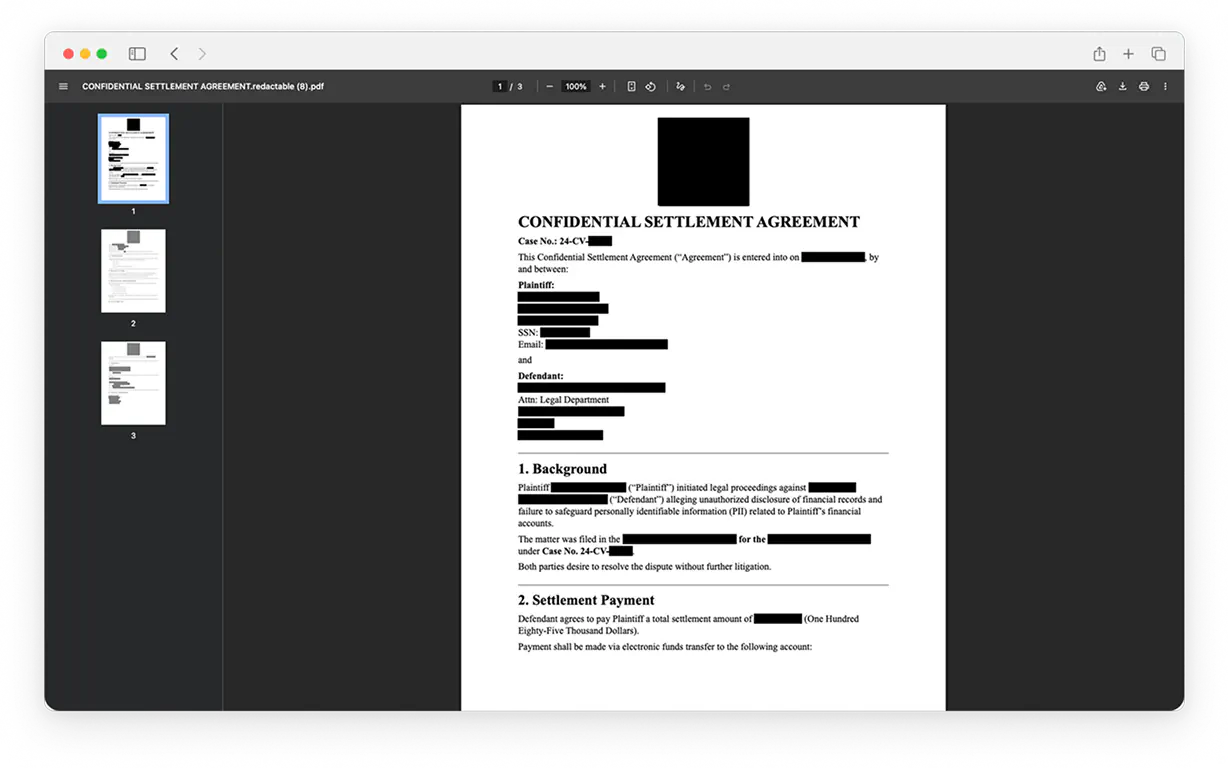
Permanent Removal That Goes Deeper Than a Black Box
Covering text in Adobe leaves the underlying data intact inside the file. Redactable removes sensitive information from the visible document and from every embedded metadata layer, hidden annotation, and file property, so it’s gone when the file leaves your system.
That level of permanence is what HIPAA, GDPR, and state insurance privacy laws actually require.
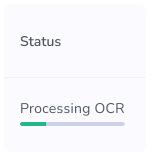
OCR Built for the Documents Insurance Teams Work With
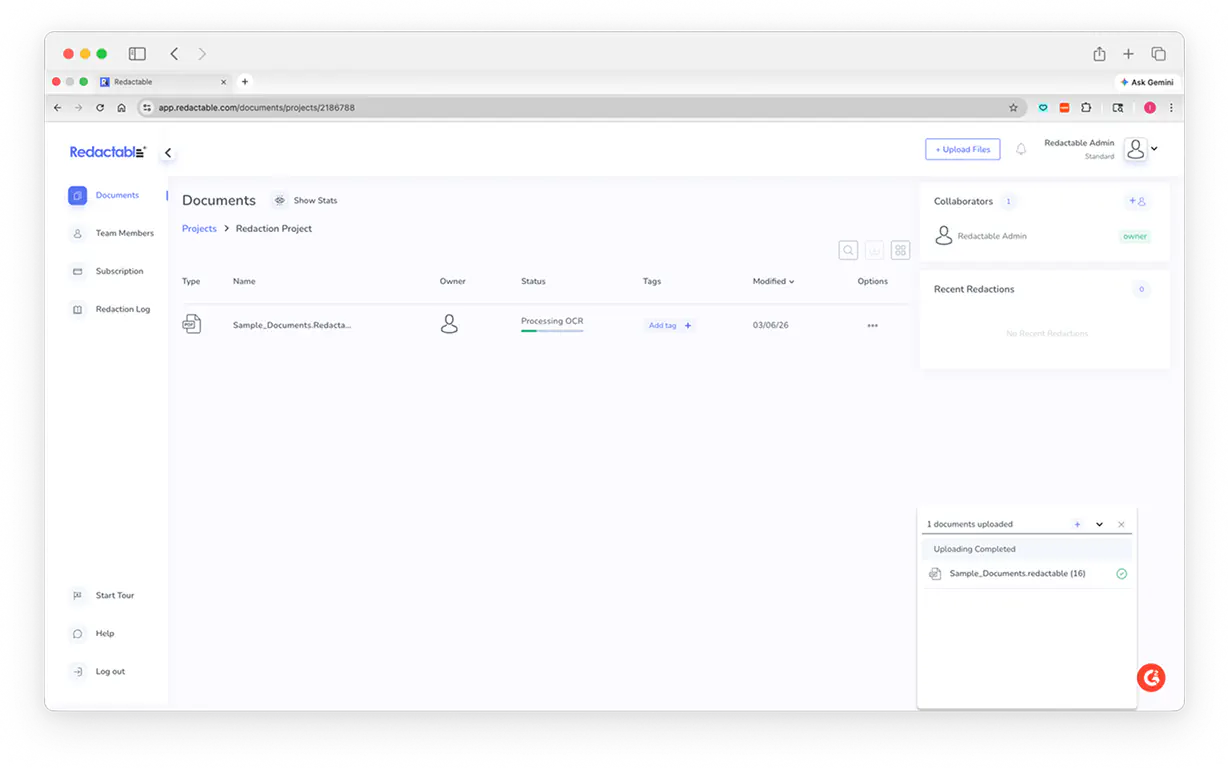
Faxed medical reports, scanned claim intake packets, photographed accident scenes, and handwritten adjuster notes don't cooperate with standard redaction tools.
Redactable converts those image-based files into fully searchable documents before running detection, so a decades-old paper claim scanned into your system gets the same coverage as a native digital file created today.
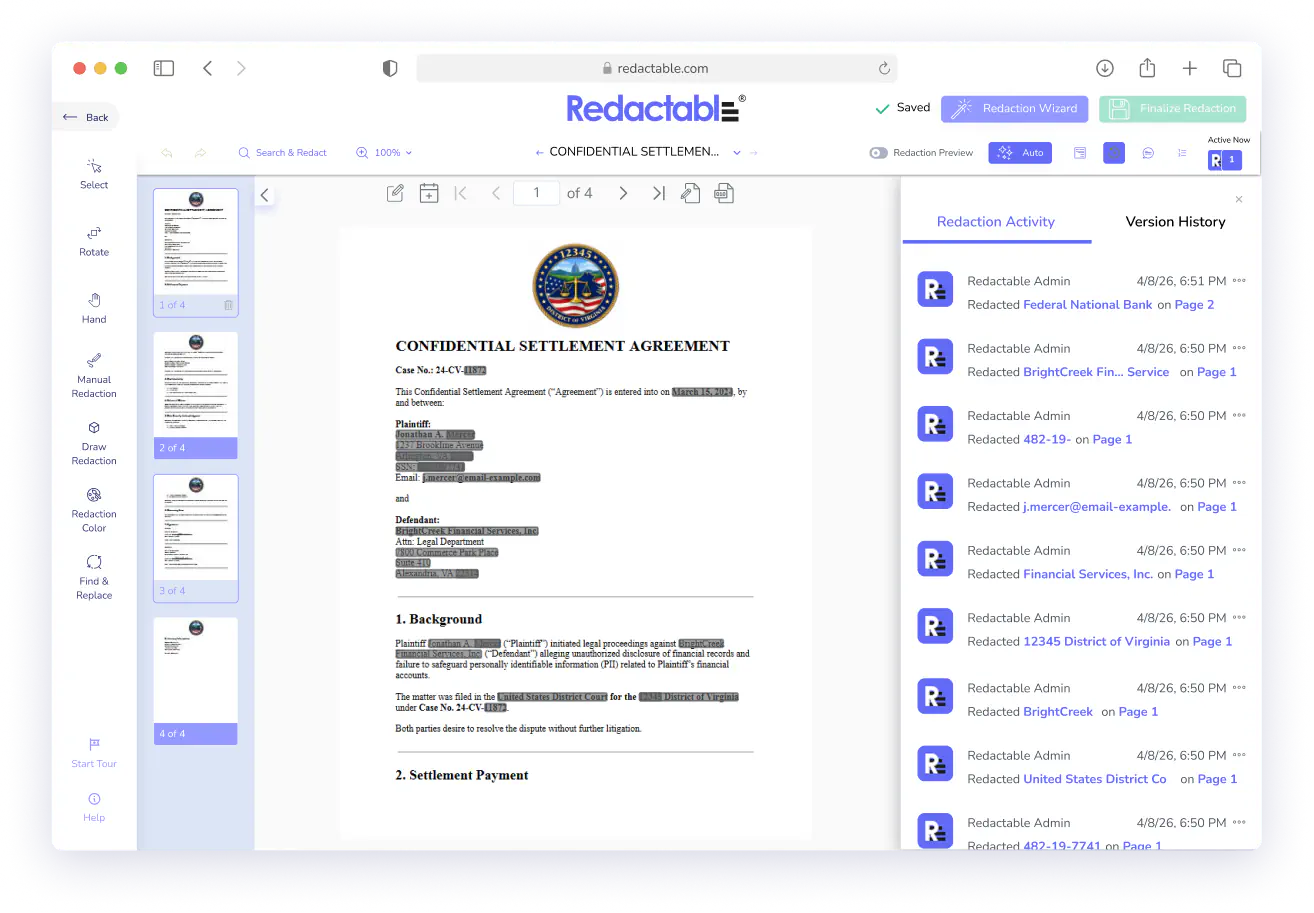
Redaction Logs That Hold Up in a Regulatory Audit
When a state insurance commissioner or HIPAA auditor asks how your team handled a specific disclosure, you need documentation.
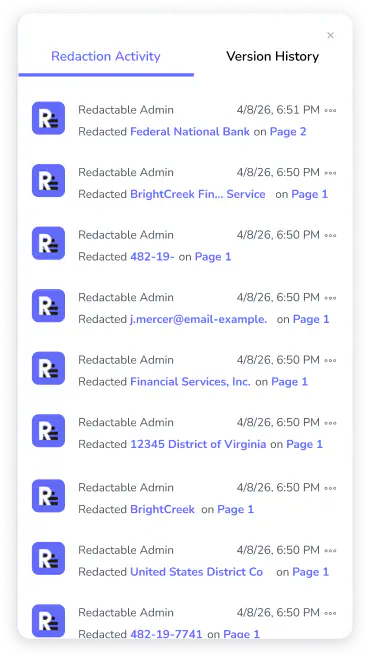
Redactable logs every redaction automatically, who made it, what was removed, which page, and when, and generates a formatted redaction report your compliance team can produce on demand.
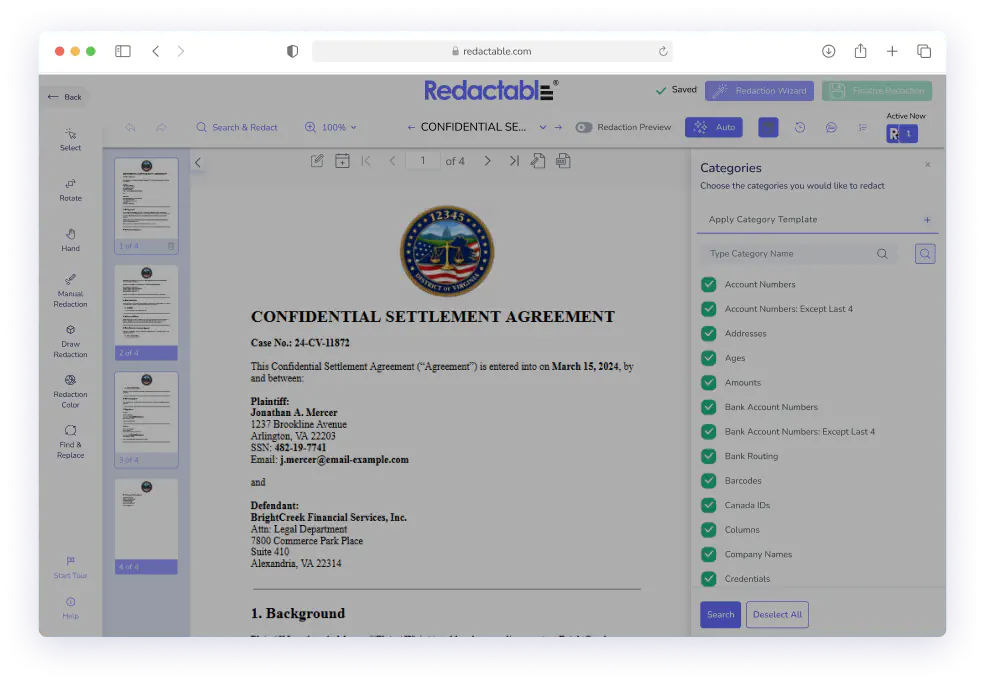
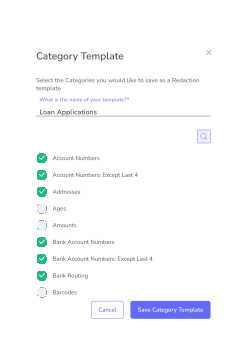
Redaction Templates Built Around Insurance Document Structures
Claim files follow a structure. So do investigation reports and medical records. Redactable lets your team build a template for each document type once and apply it to every new file with a single click.
Stop relying on individual staff members to catch every sensitive field, and make data protection consistent across the entire operation.
How Redactable Works


Six Ways to Protect Sensitive Data in Insurance Documents

See What Our Clients Have to Say
Security & Compliance Info

Ready to get started?
Frequently Asked Questions
Insurance documents contain some of the most sensitive personal data that exists, including medical records, Social Security numbers, financial details, and detailed accounts of accidents, injuries, and disputes. Redaction for insurance is the process of permanently removing sensitive information before claim files or policy documents are shared with external parties. Without it, a single disclosure can expose your organization to HIPAA violations or state regulatory fines. You may even find yourself with the kind of data breach that ends up in the news. Proper document redaction is not optional under HIPAA, GDPR, CCPA, or most state insurance privacy laws.
The list is longer than most claims teams expect. Personally identifiable information covers Social Security numbers, dates of birth, driver's license numbers, home addresses, and contact details. Protected health information includes medical history, treatment records, diagnoses, and any data that connects an individual to a health condition. Financial data includes bank account numbers, income documentation, and payment records submitted as part of a claim. When producing documents in response to a data access request or litigation hold, teams must also redact personal identifiers belonging to third parties, such as other claimants and witnesses. Embedded metadata in digital files adds another layer, often containing author names and sensitive details invisible to the naked eye.
Insurance companies operate under overlapping federal and state requirements. HIPAA governs protected health information in medical claims, disability files, and benefits documentation. The Health Insurance Portability and Accountability Act requires covered entities and their business associates to safeguard PHI throughout its lifecycle. GDPR applies to any organization processing personal data belonging to EU residents, including policyholders and claimants. CCPA gives California residents the right to access and request deletion of their personal data. State insurance departments layer additional requirements on top of those, and they vary significantly by jurisdiction, which is why a repeatable, documented redaction process matters more than a one-time fix.
During normal claims processing, files move between adjusters, medical reviewers, reinsurers, and vendors. Each transfer is a potential exposure point if sensitive personal data isn't removed first. In litigation, the stakes go up. Claim files submitted as exhibits or produced in discovery must protect privileged information and policyholder PII while still providing the relevant documents the other side is entitled to see. The challenge is that a single claim file often contains data belonging to multiple individuals, such as the claimant, treating physicians, witnesses, and third-party defendants. Redaction software that can distinguish between those individuals and redact only the necessary information is the only way to meet that standard at scale.
Yes. Redactable's built-in OCR converts image-based files into fully searchable documents before running any redaction detection. That means handwritten adjuster notes, faxed medical certifications, photographed accident reports, and paper claim files scanned years ago all get processed the same way as a document created in Word this morning. If it came into your system as an image, Redactable can read it.
There are two problems with both of those approaches. First, blacking out text in Adobe covers sensitive content visually but often leaves the underlying data intact inside the document's structure, meaning anyone who knows where to look can still access it. Redactable permanently deletes sensitive content from every layer of the file. Second, manual redaction under claims volume and deadline pressure is where human error happens. Staff miss instances, work inconsistently across document types, and have no way to prove what was reviewed. Redactable automates detection and logs every action, solving both problems at once. Redactable makes it easy to work quickly and hit deadlines without worrying about human error.
Yes. Redactable supports batch uploads of up to 100 documents, with each document containing up to 15,000 pages. For insurance companies processing large claim volumes, handling regulatory requests, or preparing discovery productions, Redactable allows your team to process large volumes of files in the time it used to take to manually review one. Custom redaction templates keep every document type consistent without requiring staff to make judgment calls on each new file.
Over-redaction is a real compliance risk. Removing information the requesting party is legally entitled to see can be just as problematic as under-redaction. Redactable's category templates and custom redaction lists let your team define exactly what gets flagged for each request type. When responding to a data access request from one claimant, you build a template that targets third-party identifiers while leaving that claimant's own information fully intact. The result is a production that gives regulators or claimants only the necessary information, nothing more, nothing less.
Yes. Redactable offers a free trial with no credit card required. Upload a real claim file, run the AI detection, and see how the platform handles your actual documents before making any decisions.

Over 98% time savings with AI-powered redaction

