In today’s data-driven enterprise, information moves faster and further than ever before. Legal teams exchange contracts with outside counsel, healthcare organizations share patient records across networks, and financial institutions manage vast archives of client data. Each document, email, or report may contain sensitive details - personally identifiable information (PII), protected health information (PHI), or confidential business data - that, if exposed, could result in regulatory penalties, reputational damage, and loss of trust.
Yet, while enterprises invest heavily in cybersecurity and access control, one critical layer of protection remains inconsistently applied: document redaction. Redaction isn’t just for court filings or privacy requests - it’s an essential safeguard that should be embedded directly into every document workflow, from creation to collaboration to archive.
This article explores why redaction must evolve from an afterthought to a built-in capability, how automation makes it scalable, and how Redactable’s AI-powered solution helps enterprises integrate compliance and confidentiality into their daily operations.
The hidden cost of unredacted documents
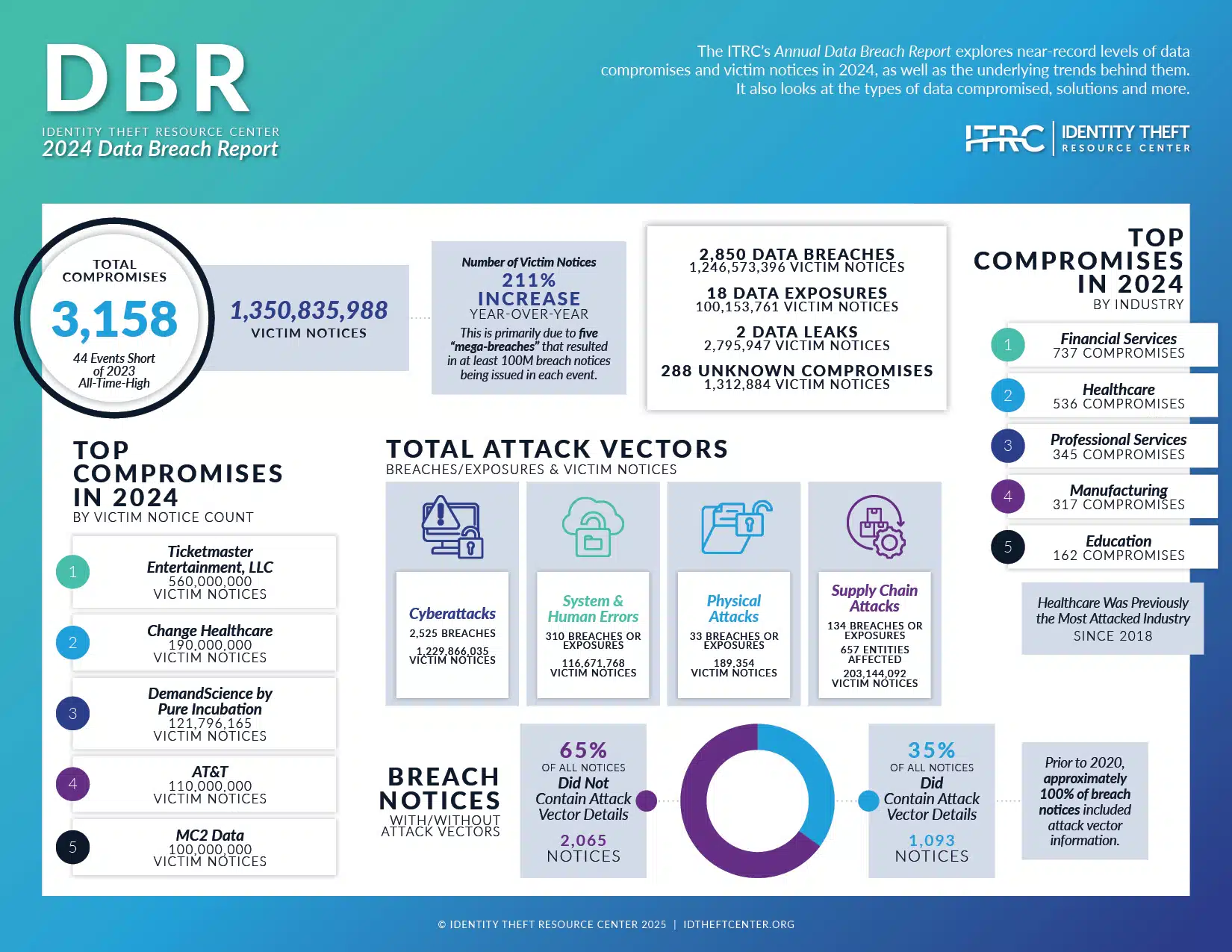
Most data breaches don’t start with hackers — they start with human error. A single overlooked name in a contract, an unredacted email chain, or a metadata-filled PDF can compromise compliance. In 2024, data exposure from document mishandling accounted for nearly 20% of reported privacy incidents across regulated sectors. The average cost of a data breach in healthcare alone in 2025 exceeds $7 million, and legal firms continue to experience reputational fallout from leaked filings and discovery errors.
Enterprises spend millions on encryption, VPNs, and identity management - yet documents, the very vessels of sensitive information, often circulate without built-in safeguards. Without proactive redaction, sensitive information can persist through versions, attachments, and archives. Worse, even deleted text or hidden comments can resurface during litigation or audits.
The invisible threat: metadata and revision history
Beyond visible text, documents carry hidden layers of sensitive information that most organizations overlook: metadata and revision history. Every Word document, PDF, or spreadsheet contains embedded details - author names, edit timestamps, file paths, previous versions, tracked changes, and even deleted comments. These invisible elements can expose confidential strategy discussions, internal negotiations, or personally identifiable information that was "removed" but never truly deleted.
In legal discovery, metadata leaks have revealed attorney work product. In M&A deals, revision history has exposed negotiation tactics. In healthcare, file properties have disclosed patient identifiers that were redacted from the visible document but remained in the metadata layer.
Effective redaction must address both what you see and what you don't. Stripping metadata and flattening revision history ensures that sensitive information is permanently removed—not just hidden. Redactable automatically cleanses documents of metadata, tracked changes, and embedded objects, ensuring complete protection before files are shared, archived, or presented in legal proceedings.
Why built-in redaction is non-negotiable
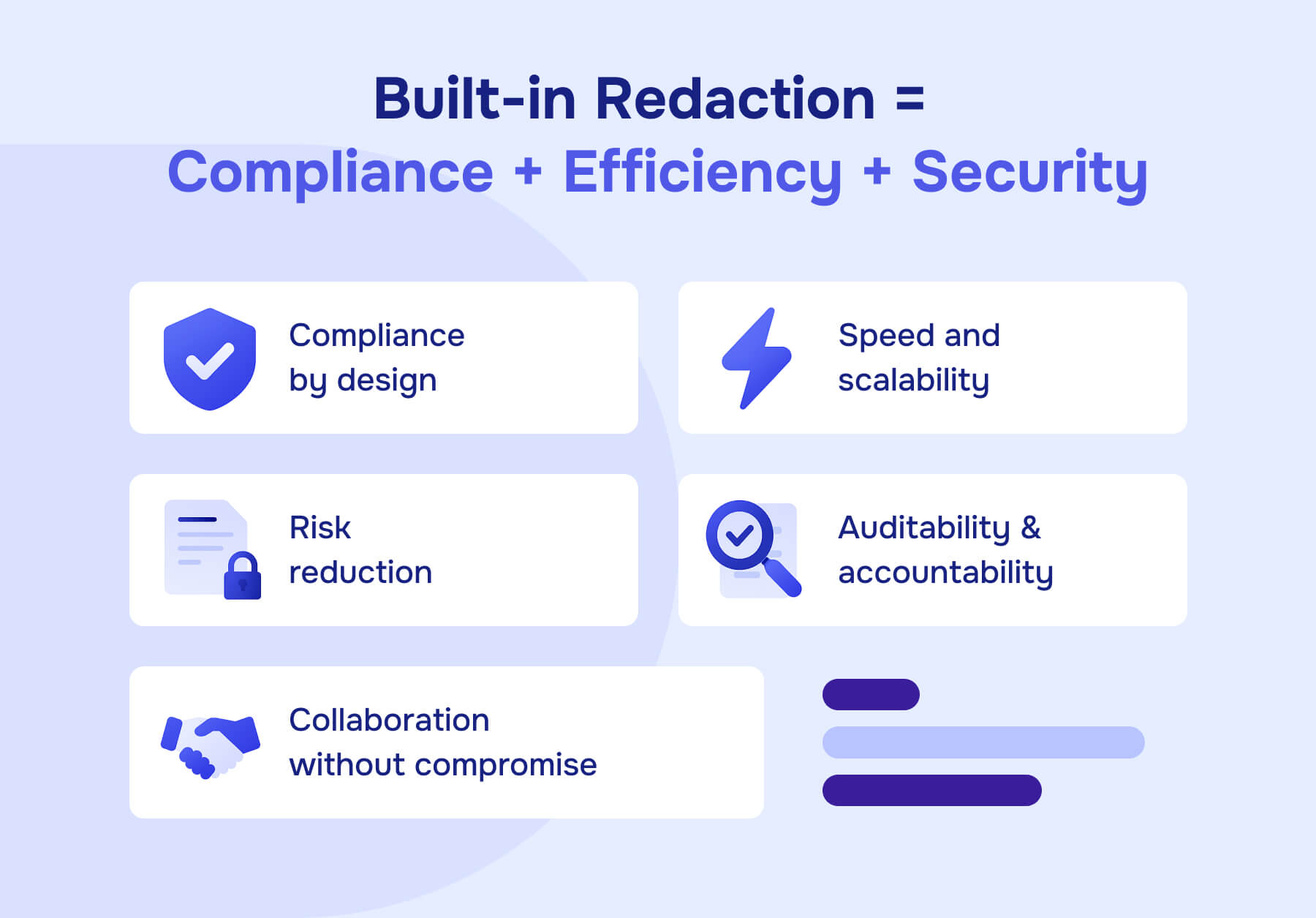
- Compliance by design – Regulations such as HIPAA, GDPR, CCPA, and FINRA mandate strict data minimization and protection practices. Embedding redaction ensures every outgoing or shared document automatically complies without relying on manual checks.
- Speed and scalability – Modern enterprises process thousands of documents daily. Manual redaction is slow and error-prone. Built-in redaction automates detection of sensitive information, reducing review cycles from hours to minutes.
- Risk reduction – Automated redaction removes the most common source of data leakage: human oversight. It ensures that every document passing through internal or external channels is sanitized by default.
- Auditability and accountability – Integrated redaction creates an auditable trail, recording what was removed, when, and by whom. This transparency not only strengthens compliance but also builds defensible documentation for regulators and clients.
- Collaboration without compromise – In an era of cloud sharing and remote work, documents often pass through multiple systems. Embedded redaction allows safe collaboration across teams, clients, and partners - without risking exposure.
How redaction fits into the enterprise document lifecycle
To understand why redaction must be built into workflows, consider the typical document lifecycle: creation, review, approval, distribution, and retention. At each stage, sensitive data can be introduced, duplicated, or inadvertently shared. Integrated redaction provides protection across every step:
- Creation: Detect and flag confidential content as it’s entered, prompting authors to redact before saving or sending.
- Review: Apply automated redaction in collaborative environments like Microsoft 365, Google Workspace, or DMS platforms to prevent accidental disclosure.
- Approval: Before documents are finalized, ensure all identifiers, client names, or proprietary data are masked or anonymized.
- Distribution: Apply redaction rules automatically before documents leave secure boundaries (via email, shared drives, or e-signature portals).
- Retention: When archiving or disposing of data, redaction guarantees long-term privacy, even if documents are later retrieved or reused.
Redactable integrates seamlessly into these stages through API and workflow automation, ensuring privacy is proactive, not reactive. With Redactable, organizations can enforce consistent redaction policies across every department and platform - from HR to legal to operations.
Redaction in action: Industry perspectives

- Legal services: Law firms handle vast volumes of discovery material, client correspondence, and filings. A missed identifier can jeopardize privilege or violate confidentiality agreements. By embedding Redactable’s AI-powered redaction directly into document management systems, firms ensure that privileged and personal data never leave a document unprotected.
- Healthcare: Hospitals and research organizations share PHI daily across EHRs, insurers, and research databases. HIPAA requires the removal of 18 specific identifiers before data can be disclosed. Automated redaction within document workflows reduces compliance risk and administrative burden, allowing clinicians and researchers to focus on outcomes instead of paperwork.
- Financial services: Banks and insurers face strict confidentiality mandates under GLBA, SOX, and PCI-DSS. Embedding redaction in daily workflows ensures that credit card data, SSNs, and account numbers are never exposed during loan processing or reporting.
The role of AI in automating enterprise redaction
Traditional redaction methods rely on manual search or template matching - approaches that struggle with scale and unstructured data. Redactable’s AI engine uses natural language processing (NLP), pattern recognition, and context-aware algorithms to detect sensitive entities beyond predictable keywords.
AI-driven redaction adapts to new document types, learns from feedback, and maintains high recall and precision rates across languages and formats. The result: a self-improving privacy layer that scales effortlessly as your enterprise grows.
Turning compliance into competitive advantage
Enterprises that treat compliance as strategy, not bureaucracy, gain an edge. Clients, regulators, and investors increasingly assess privacy posture as part of corporate credibility. When redaction is automated and auditable, it demonstrates governance maturity and builds trust.
Embedding Redactable into document workflows turns a compliance cost center into an operational advantage: reduced review time, faster contract turnaround, lower risk exposure, and improved collaboration confidence.
Moreover, built-in redaction simplifies regulatory audits. Instead of scrambling to prove data minimization, enterprises can produce logs showing exactly how sensitive information was sanitized in every workflow.
Implementing built-in redaction successfully

Map sensitive data flows – Identify where PII, PHI, or confidential data appear across documents and systems.
- Automate early – Integrate redaction at document creation, not after publication.
- Centralize policies – Maintain consistent redaction rules across departments and geographies.
- Train & monitor – Educate staff on redaction practices while monitoring performance through analytics.
- Leverage APIs – Use Redactable’s API integrations to connect redaction with CRM, DMS, and cloud storage solutions.
- Audit frequently – Review redaction accuracy and compliance metrics regularly.
Redactable simplifies implementation by embedding directly into document ecosystems - eliminating manual uploads or exports. This frictionless approach accelerates adoption while ensuring compliance from day one.
Conclusion
Redaction is no longer a reactive task - it’s an operational necessity. By embedding it into every document workflow, enterprises safeguard data integrity, maintain compliance, and accelerate productivity. Redactable enables this transformation with AI-driven automation, real-time detection, and audit-ready reporting. For organizations striving to balance agility with accountability, built-in redaction is not optional - it’s essential infrastructure.