
Key Takeaways:
- If it's not documented, regulators treat it as if it didn't happen missing records are their own violation, separate from whatever else went wrong
- Compliance documents contain the exact data that triggers breaches: personal identifiers, financial details, health information, and proprietary business data hiding inside "boring" administrative files
- Building a defensible documentation framework means explaining decisions, not just recording them auditors need to reconstruct what happened without interviewing your team
Who It’s For:
- Compliance officers and legal teams who need to produce records under audit, subpoena, or regulatory examination without over-disclosing sensitive data in the process
- IT and security managers responsible for maintaining audit trails, access logs, and incident reports that double as both compliance evidence and high-value targets
- Operations and risk leaders at organizations subject to multiple regulatory regimes who need a practical framework for what to keep, how long to keep it, and when to redact before sharing
You respond to a security incident or internal complaint and realize you can't show who accessed a sensitive file, which policy applied, or who signed off on an exception. Your biggest risk isn't just the event - it's your missing paper trail.
Regulators and auditors work from a simple principle: if it's not documented, it didn't happen. Organizations are expected to show written proof of compliance, not just claim they follow the rules. In many regimes - OSHA, financial regulation, export control, FDA Good Manufacturing Practices - failure to keep required records is its own violation, even if you were otherwise doing the right thing in practice.
This creates a documentation paradox for corporate teams: the records that prove your compliance (policies, logs, audit trails) contain exactly the data that triggers breach notifications, regulatory penalties, and litigation: personal identifiers, health information, financial details, proprietary business data. One careless disclosure turns proof of compliance into evidence of failure.
This guide explains what compliance documentation actually is, which types of records matter most, what sensitive data hides inside "boring" compliance files, and how to build a defensible documentation framework that stands up to audits without creating new data protection failures.
What does a compliance documentation framework entail?
Compliance documentation is the organized collection of records, policies, procedures, and evidence that demonstrate adherence to laws, regulations, and internal standards. It's your organization's "receipt trail" - the proof that you're meeting legal and regulatory requirements, not just asserting compliance. Understanding what a compliance documentation framework entails is the starting point for any defensible program.
Why is compliance documentation important?
Government and industry frameworks consistently emphasize written policies, logs, and evidence as foundational to any compliance program:
- Export control programs explicitly require written compliance manuals and documented procedures
- FDIC compliance review workpapers must document procedures used, analyses conducted, and conclusions reached, in proportion to risk
- NIST guidance on log management and audit trails requires documented policies and protected logs
Documentation supports and validates your compliance efforts: it shows who did what, when, under which policy, and with which approvals. Without it, regulators have no way to verify your compliance claims, and you have no defense when things go wrong.
Compliance documents vs. document compliance: clearing up the confusion
These terms sound similar but mean different things:
| Concept | What it means | Typical owner | Examples |
|---|---|---|---|
| Compliance documents | Formal records proving the organization adheres to laws and internal standards | Compliance, risk, legal, security | Policies, SOPs, logs, licenses, audit reports, training records |
| Document compliance | Making each individual document meet applicable rules (content, redaction, access, retention) | Business units + legal/compliance | Ensuring contracts include required clauses; redacting PHI before disclosure; applying retention tags |
This guide focuses on compliance documents - the records that prove adherence - but also addresses document compliance when explaining how to protect sensitive data inside those records before sharing them externally.
What are the main types of compliance documents and what data do they contain?
Understanding what a compliance document is and what counts as one matters because these records trigger both retention obligations (you must keep them) and protection obligations (you must secure them).
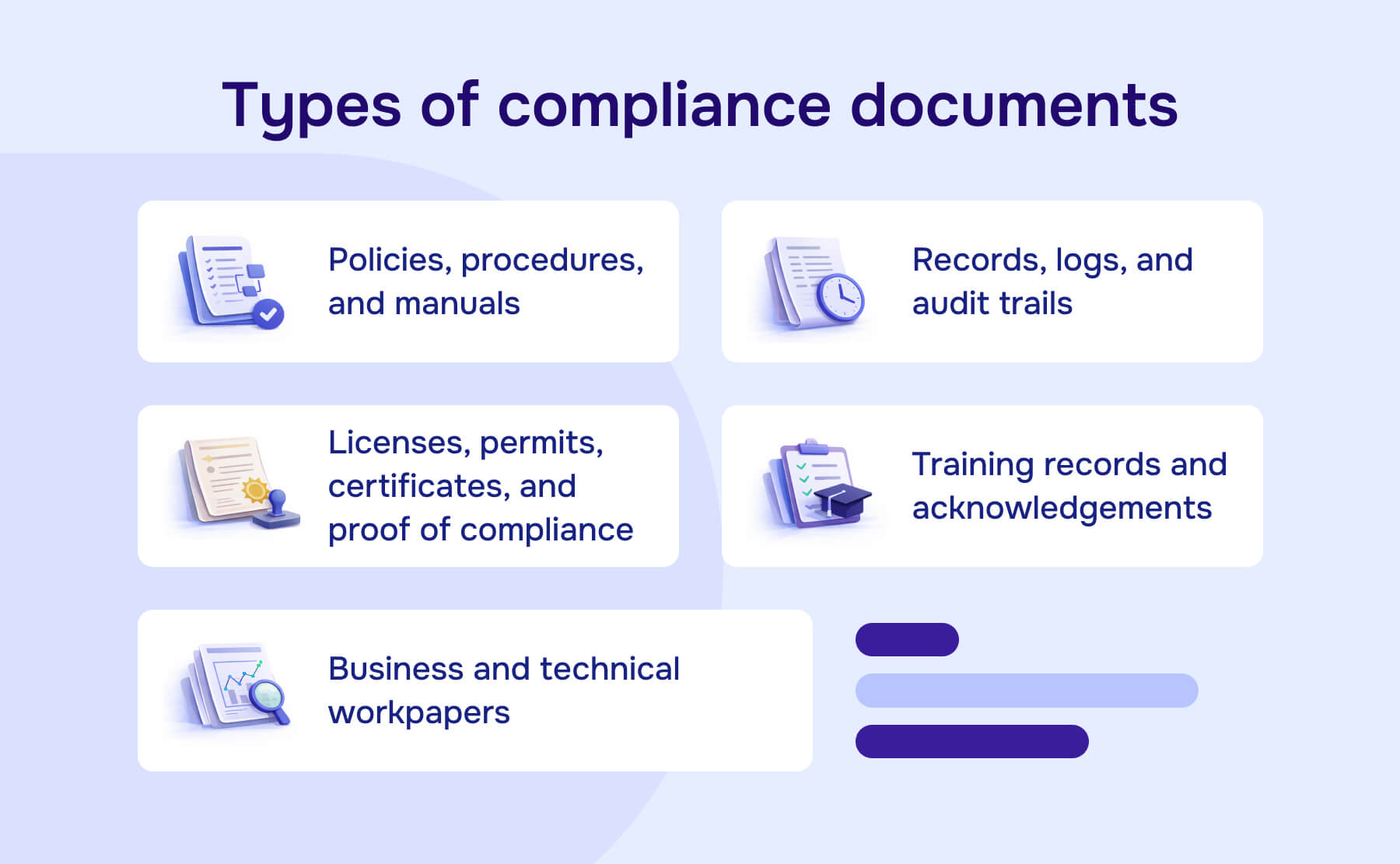
1. Policies, procedures, and manuals
Written compliance manuals and standard operating procedures provide the "map" employees are expected to follow. Export control programs, NIST-aligned security frameworks, and financial services regulations explicitly require documented policies and procedures.
What these documents typically contain:
- Role descriptions and responsibilities
- Escalation paths and approval workflows
- Decision-making criteria and thresholds
- Contact information for compliance officers and key personnel
Sensitive data concerns: While policies themselves may not contain highly sensitive personal data, they often identify specific roles, names, and organizational structures that need controlled access - especially when policies address security controls, incident response, or privileged access management.
2. Records, logs, and audit trails
Logs and audit trails are critical evidence of day-to-day compliance in security, safety, and financial contexts. They answer the question: "Can you show me what actually happened?"
Common types include:
- System access logs (who accessed what, when)
- Change records (configuration changes, permission modifications)
- Incident reports and response documentation
- Transaction logs (financial systems, healthcare records systems)
- Security event logs and SIEM outputs
Sensitive data concerns: NIST guidance treats audit trails as security-relevant records that must be protected against tampering and unauthorized access because they reveal sensitive operational data and often contain personal identifiers, account numbers, IP addresses, and behavioral patterns.
A transaction log showing account access patterns, for instance, isn't just "technical data"—it's evidence of financial activity that may constitute nonpublic personal information (NPPI) under GLBA or protected health information (PHI) under HIPAA.
3. Licenses, permits, certificates, and proof of compliance
Many regulators define specific "proof of compliance" documents: tax clearances, certificates of good standing, regulatory licenses, and other certificates that must be retained and produced on request.
Examples across industries:
- Business licenses and permits
- Professional certifications (medical licenses, bar admissions, engineering certifications)
- Environmental permits and waste disposal records
- Export licenses and end-use certifications
- Safety inspection certificates and equipment calibration records
Sensitive data concerns: These documents carry business identifiers, physical addresses, contact names, and sometimes financial information (bonding amounts, insurance coverage). They're often treated casually in shared folders despite containing data that needs secure handling.
4. Training records and acknowledgements
Compliance documentation frequently includes training attendance logs, signed policy acknowledgements, and exam results as evidence that staff were informed and tested.
What's typically documented:
- Training session attendance (dates, participants, instructors)
- Policy acknowledgement signatures with timestamps
- Competency assessments and exam scores
- Certification renewals and continuing education credits
- Role-specific training for access to sensitive data or systems
Sensitive data concerns: These records contain personal data (employee names, IDs, performance metrics, sometimes disciplinary notes) that trigger privacy obligations. When shared externally - during audits, investigations, or in response to complaints - they often require redaction of third-party employee information or performance details not relevant to the inquiry.
5. Business and technical workpapers
In regulated sectors (finance, pharma, healthcare), exam and validation workpapers must docuent procedures performed, test results, and conversations with management.
Examples include:
- Internal audit workpapers showing sampling methodology, findings, and management responses
- Compliance review notes from regulatory examinations
- Validation protocols for software, equipment, or processes
- Risk assessments with scoring, mitigation plans, and approval records
- Quality control and GMP documentation in pharmaceuticals and medical devices
Sensitive data concerns: Workpapers often embed highly sensitive operational details, financial performance data, clinical trial information, and strategic discussions. They require strict access controls and, when shared with auditors or regulators, careful redaction of out-of-scope proprietary information or third-party confidential data.
What sensitive data hides inside compliance documents?
Compliance documents feel administrative - policies, logs, certificates - but they're full of personal identifiers, health data, financial details, and proprietary information.
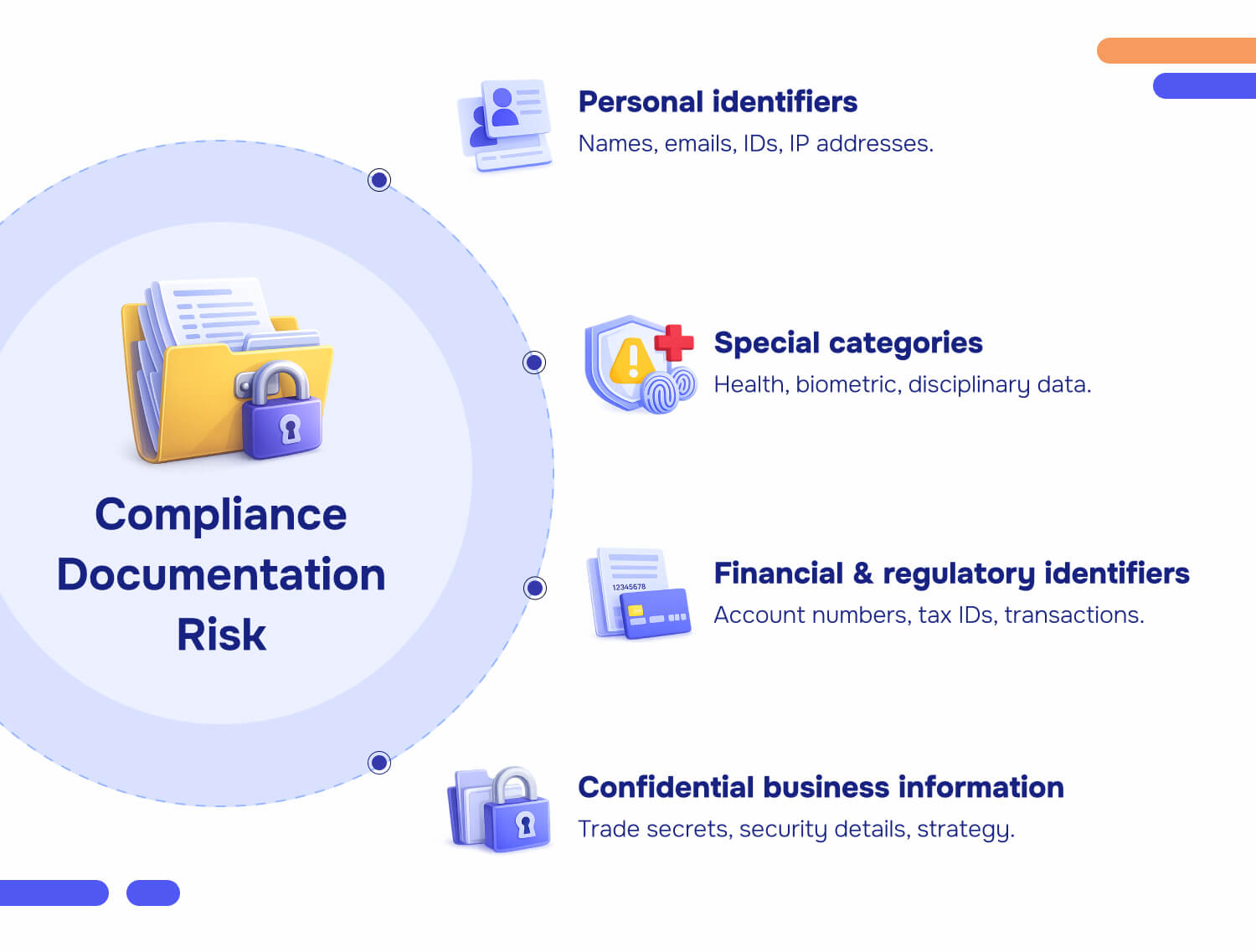
Common sensitive data categories in compliance documentation
Personal identifiers:
- Employee names, IDs, contact details in training logs and HR compliance files
- User account names and email addresses in access logs
- IP addresses and device identifiers in security event logs
Special categories (high-sensitivity personal data):
- Protected health information (PHI/ePHI) in healthcare compliance logs and incident reports
- Union membership or disciplinary records in labor compliance documentation
- Protected class information (race, gender, disability status) in equal opportunity compliance reporting
- Biometric data in physical security or time-tracking compliance records
Financial and regulatory identifiers:
- Account numbers and transaction details in financial services audit trails
- Tax identification numbers in licensing and permit documentation
- Social Security numbers in employee training and certification records
- Credit information in vendor due diligence workpapers
Trade secrets and confidential business information:
- Proprietary processes and formulas in quality compliance documentation
- Security architecture details in risk assessments and incident response plans
- Strategic information in regulatory filings and audit workpapers
- Customer lists and pricing models in contract compliance reviews
Why "boring" documentation becomes high-value targets
NIST and GMP-style guidance highlight that logs and records themselves become sensitive assets that must be protected, backed up securely, and controlled through access restrictions and change control.
The paradox: the same audit trails and logs that prove your security controls are working also reveal exactly how your systems are configured, where sensitive data lives, and which accounts have privileged access. In the wrong hands, compliance documentation becomes a roadmap for attackers or competitors. Proper documentation proves you're following the rules, but it also contains exactly the data that triggers breach notifications and regulatory penalties.
When redaction and anonymization become mandatory?
Compliance documentation must be retained for regulatory purposes - but that doesn't mean everyone who asks for it should see everything in it.
Scenarios requiring redaction of compliance documents
- Regulatory examinations and audits: When industry regulations give regulators authority to examine your records, the scope of that authority determines what they're entitled to see. If your incident report contains PHI or details about unrelated security controls, you may need to provide a redacted version that responds to the specific inquiry without disclosing out-of-scope sensitive information.
- Freedom of Information Act (FOIA) and open records requests: Government agencies and publicly funded entities must respond to public records requests, but certain exemptions protect personal privacy, trade secrets, and security-related information. Compliance with FOIA means redacting exempted information before release, not refusing to produce records entirely.
- Litigation discovery and subpoenas: Compliance documents are frequently requested in lawsuits and investigations. Courts require parties to produce relevant documents but also recognize privileges (attorney-client, work product) and privacy protections. Producing compliance workpapers without redacting third-party employee details, privileged communications, or confidential business information can waive protections or create new liability.
- Vendor due diligence and third-party audits: When business partners, investors, or certification bodies request evidence of compliance, they need to see proof of controls—but not necessarily sensitive operational details, employee personal information, or customer data embedded in your logs and reports.
- Internal investigations and whistleblower complaints: HR investigations, ethics inquiries, and compliance reviews generate documentation that often includes witness statements, employee performance data, and disciplinary records. Sharing this documentation with parties who have a legitimate need to know requires careful redaction of details not relevant to the specific inquiry.
What document compliance requires before external sharing
Effective compliance means ensuring each document shared externally matches legal disclosure rules while still serving as defensible evidence. Practical requirements include:
- Confirm scope: Verify that what you're sharing responds to the actual request or legal obligation - no more, no less
- Remove out-of-scope personal data: Redact employee names, contact information, and performance details not relevant to the inquiry
- Check metadata: Strip document properties, edit history, author information, and embedded comments that reveal more than intended
- Validate redactions: Ensure redacted information is permanently removed from the document structure, not just visually covered
- Document the process: Record what was redacted, why, under which legal basis, and who approved the disclosure
How do you build a defensible compliance documentation framework?
Effective compliance documentation isn't about generating more paperwork - it's about creating the right records, protecting them appropriately, and being able to produce them when needed. Organizations operating under multiple compliance frameworks, such as HIPAA and SOX, or NIST and export control, often maintain overlapping documentation sets that must satisfy each regime's specific requirements.
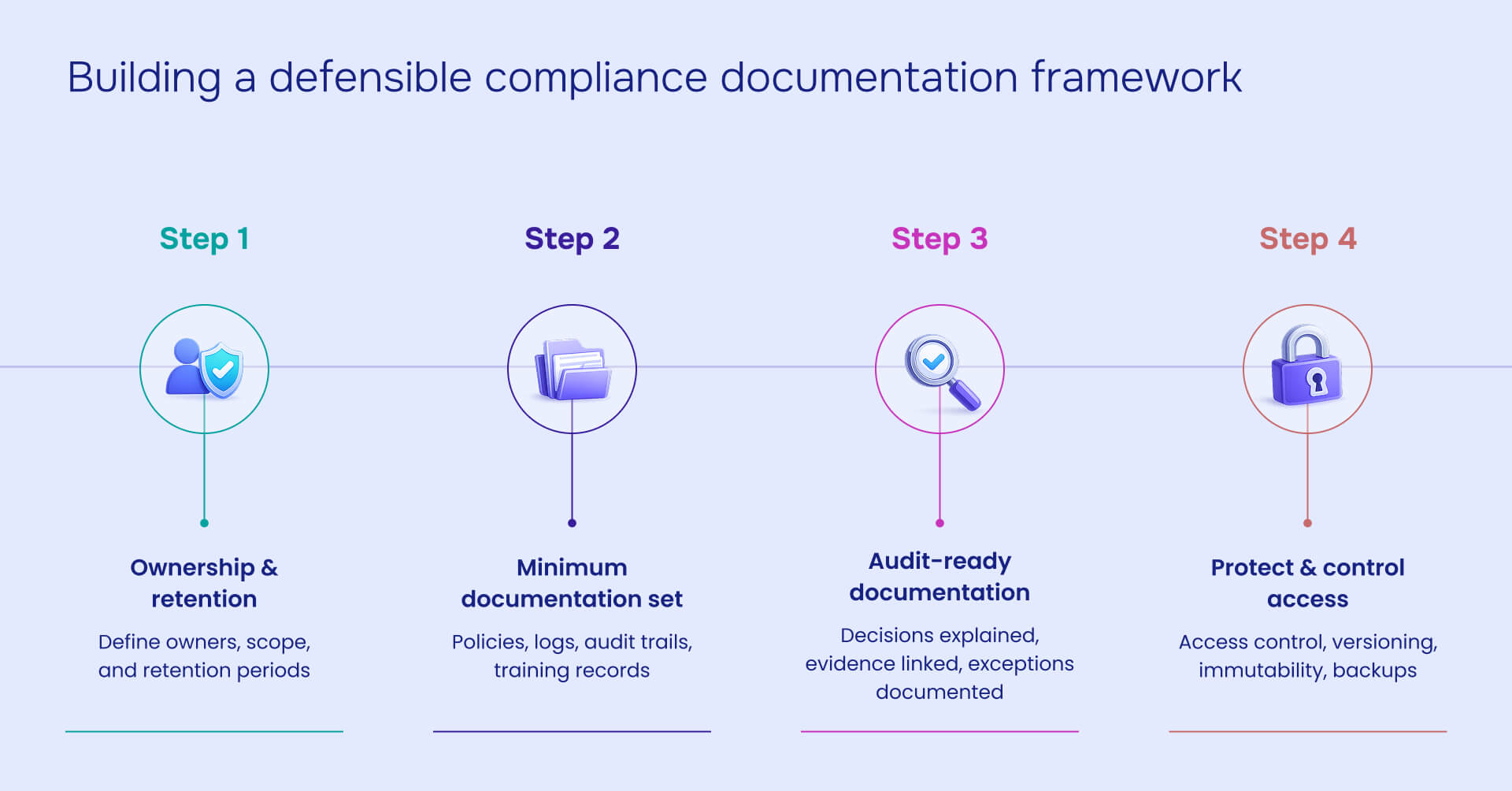
Step 1: Define ownership, scope, and retention
Good practice from GMP and NIST-style frameworks: clearly define who owns which documents and records, how they are created, approved, maintained, and archived.
Key questions to answer:
- Who is responsible for creating, reviewing, and approving each type of compliance document?
- Where are official versions stored, and how are they distinguished from drafts?
- What are the retention periods for each document type, and who enforces destruction schedules?
- How are changes documented, and who can authorize modifications?
Retention and destruction: Many regulators specify minimum retention periods for compliance records. For example, OSHA requires injury and illness logs to be retained for at least five years, and in practice these often must be transferred when businesses are sold. Financial services firms commonly face 6-7 year retention requirements for transaction records and communications, though specific periods vary by jurisdiction and record type.
The compliance trap: keeping records too long creates unnecessary data exposure and storage costs. Destroying them too early violates retention requirements and can trigger adverse inference in litigation.
Linking controls to documented evidence is a core risk management practice that shows auditors that you identified risks and took deliberate steps to address them.
Step 2: Build your minimum documentation set
You don't need perfect documentation on day one. Start with a pragmatic "starter pack" aligned with widely used frameworks:
Written policies and procedures for key risk areas:
- Information security and access control
- Data privacy and breach response
- Anti-corruption and conflicts of interest
- Workplace safety and incident reporting
- Export control and sanctions screening (if applicable)
These structured compliance documents form the baseline most regulators expect to see during an examination.
Asset and risk register: Link controls to documented evidence (logs, reports, tests). NIST-aligned programs often maintain a control matrix mapping each required control to its implementation evidence and testing records.
Logging and audit philosophy: Document what is logged, how long logs are retained, who reviews them, and how issues are documented and escalated. NIST log management guidance emphasizes that logging policies themselves must be documented and consistently applied.
Training and acknowledgement records: Track who was trained on which policies, when, with clear scope and versioning so you can demonstrate that employees were informed of current requirements.
Step 3: Make documentation usable in real audits and incidents
FDIC and NIST-style guidance stresses that documentation must be sufficient to reconstruct what was done, which controls were tested, and how conclusions were reached - not just assert "we are compliant."
The practical test: Could a new compliance officer understand what you did and why - without talking to the original team? If not, the documentation is too thin.
What "sufficient documentation" looks like:
- Decisions are explained, not just recorded (why did you choose this control? which risks were accepted?)
- Evidence is linked to specific requirements (this log proves we meet access control requirement X)
- Exceptions and deviations are documented with approvals and time limits
- Reviews and updates are dated and attributed to specific individuals
Step 4: Protect documentation with appropriate controls
Compliance documents aren't just evidence of compliance - they're targets. NIST guidance on protecting audit trails makes clear that access to audit data itself must be restricted, logged, and protected from tampering.
Access control:
- Restrict access to compliance documentation based on role and need-to-know
- Implement separate permissions for viewing vs. editing vs. deleting
- Log all access to sensitive compliance records
Version control and immutability:
- Maintain version history showing who edited a policy, when, and what changed
- Use write-once storage or digital signatures for critical audit trails
- Protect logs from alteration or deletion by unauthorized users
Backup and disaster recovery:
- Ensure compliance documentation is included in backup procedures
- Test restoration processes to verify documentation can be recovered
- Consider separate retention for compliance records beyond standard backup schedules
Compliance documentation checklist: 90-day improvement plan
A structured documentation program isn't just about audit readiness, it also improves operational efficiency by reducing scramble time when records are requested.
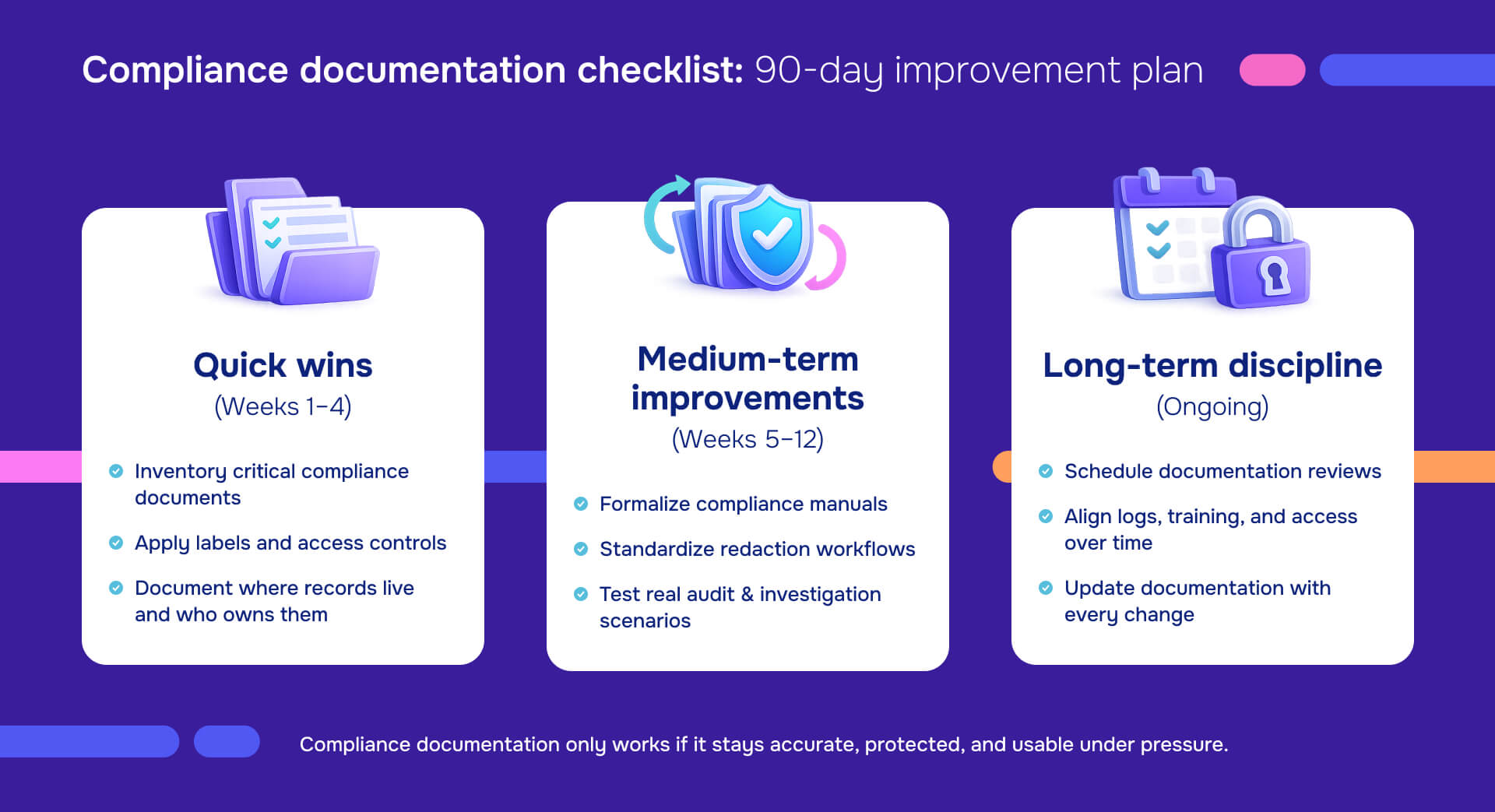
Quick wins (weeks 1-4)
Inventory your critical compliance documents: Identify your top 10-20 critical document types (policies, logs, licenses, workpapers) and list those that contain personal or highly sensitive data. Focus on records that would be requested first in an audit or investigation.
Apply basic labels and access controls: Implement consistent labels (confidential, personal data, attorney-client privileged) and basic access controls for compliance repositories. Follow NIST recommendations for protecting log data and audit trails.
Document your documentation process : Create a simple one-page guide explaining where official compliance documents live, who owns them, and how to request access. This seems basic, but many organizations fail audits because teams can't locate required records.
Medium-term improvements (weeks 5-12)
Formalize your compliance manual:Create or update your written compliance manual and documentation procedures, accessibility, and currency.
Design standard redaction workflows:Build a repeatable template for redacting and sharing compliance documents that captures:
- Scope of the request or legal obligation
- Legal basis for disclosure (subpoena, audit, vendor due diligence)
- Redaction rationale (why specific information was removed)
- Approval chain (who authorized the disclosure)
This creates auditable document compliance workflows and reduces the risk of over-disclosing or under-redacting.
Test your documentation against real scenarios:Run tabletop exercises simulating common situations:
- Regulator requests evidence of access controls
- Subpoena demands incident reports from the last two years
- Vendor asks for proof of security training
- Internal investigation requires HR compliance records
Can your team locate, review, redact (if needed), and produce the right documents within typical response timelines? If not, you've identified gaps before they become emergencies.
Long-term discipline (ongoing)
Schedule regular documentation reviews:Compliance documentation degrades over time. Policies become outdated, logs fill storage without anyone reviewing them, training records accumulate gaps. Schedule quarterly or semi-annual reviews of:
- Policy currency (do current procedures match documented procedures?)
- Log coverage and retention (are we logging what we said we'd log?)
- Training completion (are all required personnel current?)
- Access control alignment (do current access lists match documented roles?)
Integrate documentation into change management:When systems, processes, or organizational structures change, update compliance documentation as part of the change process—not as an afterthought. This prevents the drift between "what we do" and "what our documentation says we do" that regulators consistently flag as a compliance failure.
Key takeaways
What matters:
- No documentation = no proof. Regulators work from written evidence. Without documented policies, logs, and audit trails, you can't demonstrate compliance.
- Compliance documents contain the data that triggers breaches. Policies, logs, and training records hold personal identifiers, financial information, and proprietary details. Mishandling them creates the liability you're trying to prevent.
- Creating compliance documents ≠ sharing them safely. Before external disclosure, redact out-of-scope data, strip metadata, ensure permanent removal (not visual masking), and document decisions.
- Keep what you must, destroy what you should. Most compliance documents require 5-7 year retention. Longer creates exposure. Earlier violates retention rules.
- Documentation must explain decisions, not just record them. Regulators assess whether records explain what was done, why, and by whom - without needing to interview your team.
Organizations that treat compliance documentation as a checklist face missing records, over-disclosed data, and failed audits. Organizations that protect documentation deliberately turn regulatory obligations into strengths.
Ready to protect sensitive data in compliance documents before sharing? Redactable's AI-powered platform automatically detects sensitive information across 40+ categories, performs permanent redaction with guaranteed metadata removal, and generates compliance certificates for audit trails - delivering 98% time savings compared to manual redaction. Start your free trial or schedule a demo to see how automated redaction works for regulatory examinations, litigation discovery, and vendor due diligence.
Frequently asked questions
Compliance documentation is the organized collection of records, policies, procedures, and evidence that demonstrate an organization's adherence to laws, regulations, and internal standards. It includes written policies, audit trails, logs, training records, licenses, permits, workpapers, and certificates that prove compliance rather than merely assert it. Regulators and auditors rely on compliance documentation as evidence that an organization is meeting its legal obligations.
Compliance documents are the specific records and files that make up your compliance documentation. Common examples include: written policies and standard operating procedures; system access logs and audit trails; training attendance records and acknowledgements; regulatory licenses and permits; incident reports and investigation files; risk assessments and audit workpapers; and certificates proving adherence to standards or regulations. These documents serve as evidence during audits, investigations, and regulatory examinations.
Compliance documents are formal records proving organizational adherence to laws and standards (policies, logs, audit reports). Document compliance is the process of ensuring each individual document meets applicable rules for content, redaction, access control, and retention. For example, compliance documents include your security policy and access logs; document compliance means redacting PHI from those logs before sharing them with auditors, and ensuring the policy document itself has required approvals and version control.
Compliance documentation proves regulatory adherence, provides legal defense in disputes and investigations, supports audit and examination responses, demonstrates due diligence to business partners and investors, and creates accountability by showing who did what, when, and under which policy. Without documentation, regulators work from the principle that "if it's not documented, it didn't happen" - meaning your compliance claims can't be verified even if you were following rules in practice.
Compliance documents often contain: personal identifiers (employee names, IDs, contact details) in training logs and incident reports; special category data (PHI in healthcare compliance logs, union membership in labor records, protected class information in EEO reporting); financial information (account numbers in audit trails, tax IDs in licensing documents, transaction details in compliance reviews); and trade secrets (proprietary processes in quality documentation, security architecture in risk assessments, strategic information in regulatory filings).
Retention periods vary by regulation and document type. Common requirements include: OSHA injury/illness logs for at least 5 years; financial services transaction records commonly 6-7 years (though specific requirements vary by jurisdiction and record type); tax records often 7 years; employment records typically 3-7 years depending on type and jurisdiction; and litigation-related documents until the matter is resolved plus applicable statute of limitations. Many regulations specify retention requirements, and some require transfer of records when businesses are sold or closed.
Redaction becomes necessary when: responding to regulatory examinations where scope is limited to specific inquiries; complying with FOIA or open records requests that require protecting personal privacy and trade secrets; producing documents in litigation discovery while preserving privileges and confidentiality; sharing with vendors, auditors, or business partners who need proof of controls but not access to all sensitive operational details; and responding to internal investigations where witnesses or third parties must be protected. Redaction ensures documents remain compliant evidence while protecting out-of-scope sensitive information.
Visual redaction covers text with black boxes or highlights but leaves underlying data, metadata, and document structure intact—the information can often be recovered by examining file properties, version history, or hidden layers. Permanent redaction removes sensitive information entirely from the document structure, strips metadata (author names, edit history, embedded comments), and eliminates hidden data. Courts and regulators consistently expect permanent removal, not cosmetic hiding, especially when documents are produced in discovery, submitted in response to examination requests, or shared with third parties. NIST guidance on protecting logs similarly emphasizes that sensitive audit data must be protected from unauthorized access and tampering.
Access should be restricted based on role and need-to-know. Typical access tiers include: compliance officers and legal teams (broad access to create, review, and approve documentation); business unit managers (access to policies and procedures relevant to their operations); auditors and regulators (controlled access to specific documents responsive to examination scope); and vendors or third parties (limited access to proof-of-compliance documents, typically after redaction of sensitive operational details). NIST guidance emphasizes that access to audit logs and compliance records must itself be logged and monitored.
More About
Data Privacy
Start Redacting Instantly

No credit card required
Start redacting for free
Cancel any time

Over 98% time savings with AI-powered redaction

